
In the vaults of the BC Archives lies a memory of the past. In 1964, nearing the end of his days, Bentley Collingwood Hilliam sat down with Canadian Broadcasting Corporation (CBC) Radio to make a recording of his life. A now largely forgotten musical genius, Hilliam was one half of the internationally touring vaudeville act Mister Flotsam and Mister Jetsam that played the musical halls from the 1920s to the 1940s. A classically trained pianist with a gift for song writing, Hilliam got his start in North Vancouver. His journey to stardom is one that warrants a re-telling!

Bentley Collingwood Hilliam (1890-1968). Portrait from BCH’s autobiography, Flotsam’s Follies. London: Arthur Barron, Ltd., 1948.
Born in Scarborough, England in 1890, Hilliam left school at 14 and became apprenticed to a local newspaper. His true passion, however, was music. An accomplished pianist, and blessed with an ear for a tune, he began composing melodies. Aged 18, he sold his first song - Has anyone seen me rinking? - to an entertainer in Liverpool. The song earned him a guinea. Stardom, however, remained a distant dream and with the talk of the town revolving around the opportunities of migration to Canada, in 1911 he and his recently widowed mother embarked on the RMS Lusitania, bound for Montreal.
Hilliam’s neighbours in England had previously emigrated to Calgary, Alberta, so it seemed an obvious first point of call. Hilliam found work playing the piano in one of Calgary’s early cinemas, The Majestic, as well as doing cartooning work for the local Herald.
Mister Conley, The Majestic’s owner, was opening up another cinema in Fernie, British Columbia and offered Hilliam a job. Billed as ‘Professor Hilliam and Illustrated Songs’ (anyone who played the piano was a professor in Conley’s eyes) Hilliam opened at The Isis. Fernie was at the time a pioneering town, filled with miners, loggers and trappers. The ‘movies’ were silent (hence the need for a piano accompaniment) and it was an experience not without its shocks. As Hilliam describes in his CBC Radio interview:
“The piano was positioned out of range of the screen since the customers…had the habit of plugging the screen…taking pot shots with their rifles if they didn’t like what was being shown.”
On board the RMS Lusitania, Hilliam had befriended a man called Anders, a real estate entrepreneur from North Vancouver. The two men kept in touch. Anders had told Hilliam of the attractions of the (then still burgeoning) town and when a position as News Editor became available on North Vancouver’s fledgling newspaper, The Express, Hilliam decided to make the move.
The description of his and his mother’s arrival in 1912 is recounted in detail in his interview:
“I saw the north shore of the Burrard Inlet from the deck of the ferry boat…little North Vancouver huddled down on the coast line with the beginnings of the Wallace Shipyards. Grouse Mountain hanging behind, and Lonsdale Avenue leading up the mountain from the jetty…it was all in a state of sub-division, selling lots, primitive in a way, but very, very charming…about 12 blocks up before bush…the beginnings of a town. The whole place was full of possibilities.”
Hilliam and his mother moved into a house at 439 7th Street, North Vancouver, a newly built craftsman that remains standing to this day.
The recently established Express had offices on 2nd Street, around the corner from the Bank of Hamilton (recently Obsession Bikes and still standing). Two rooms in total, one for the Editor, George Morden, with a window facing the wooden sidewalk, the other, less conspicuously positioned, for the use of the newspaper’s only other employee, Hilliam.
Hilliam’s job was to attend Council meetings and report on other local happenings. Morden, his Editor, required that reports for the bi-weekly newspaper were written verbatim, however (as Hilliam jovially describes) the “forthright and fruity remarks of the civic fathers” meant that his write-ups in The Express needed to exclude the numerous “blankety blanks” reverberating off the council chamber walls, becoming, of necessity, “models of discretion.”
Although young (he was still only 21), The Express’s newly recruited News Editor had plentiful access to the town’s local dignitaries. One was Alderman Jack Loutet, later to become mayor. Loutet, “who stood poised as a question mark,” invited Hilliam to play a regular game of tennis on a Sunday, although this did not sit well with Alderman Irwin “who wielded a very well-meant moral influence over the city and the district at that time.”
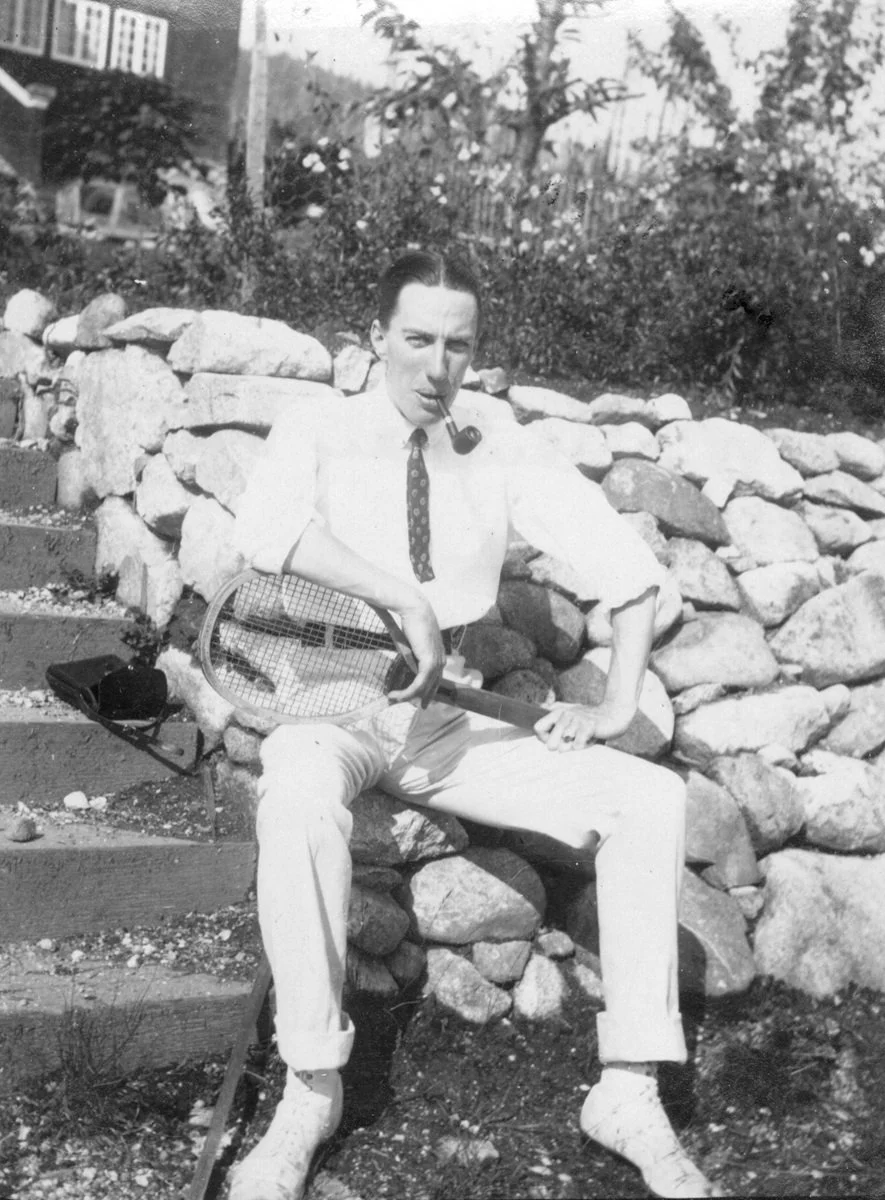
Hilliam in the back garden of Jack Loutet’s house at 177 East Carisbrooke Road, North Vancouver ca 1913. Photograph courtesy of MONOVA Archives, Inv 7880.
Things did not always go according to plan. Hilliam tells an amusing story that in advance of Prince Arthur, the Duke of Connaught’s arrival in North Vancouver in September 1912, the newspaper was informed that the Governor General’s visit was to be presented as strictly informal - a side visit from the main business in Vancouver itself. The Express printed a golden edition of the newspaper to commemorate the occasion however the first 50 copies carried Hilliam’s banner headline reading as ‘Infernal Visit of Governor General’, a typesetting error that caused much embarrassment before it was corrected.
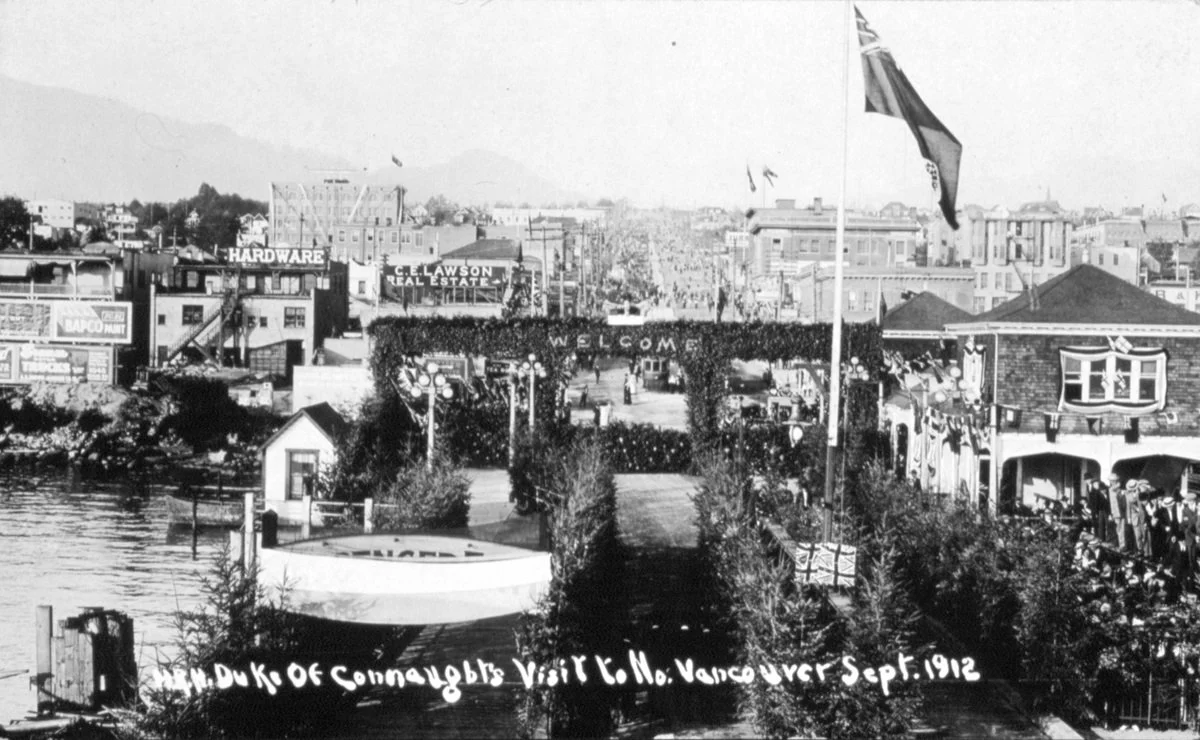
Lonsdale ferry decorated for HRH Duke of Connaught’s visit to North Vancouver, September 1912. Photograph courtesy of MONOVA Archives, Inv 12978.
By 1913, Hilliam had re-engaged with his passion, music. As he describes in his CBC Radio interview:
“An immigrant from Bradford Yorkshire, who styled herself Madam Norminton, a handsome woman, rather remindful of Clara Butt, was teaching singing and had formed a concert party which she called The Smart Set. She was agreeable to anything I promoted. We merged, together becoming The Queries…a note of interrogation because they never knew what we were going to sing.”
Dressed in white Pierrot costumes (“I wore black…as befitted the policier of the troupe.”) The Queries performed at the Lonsdale Theatre and other local halls.
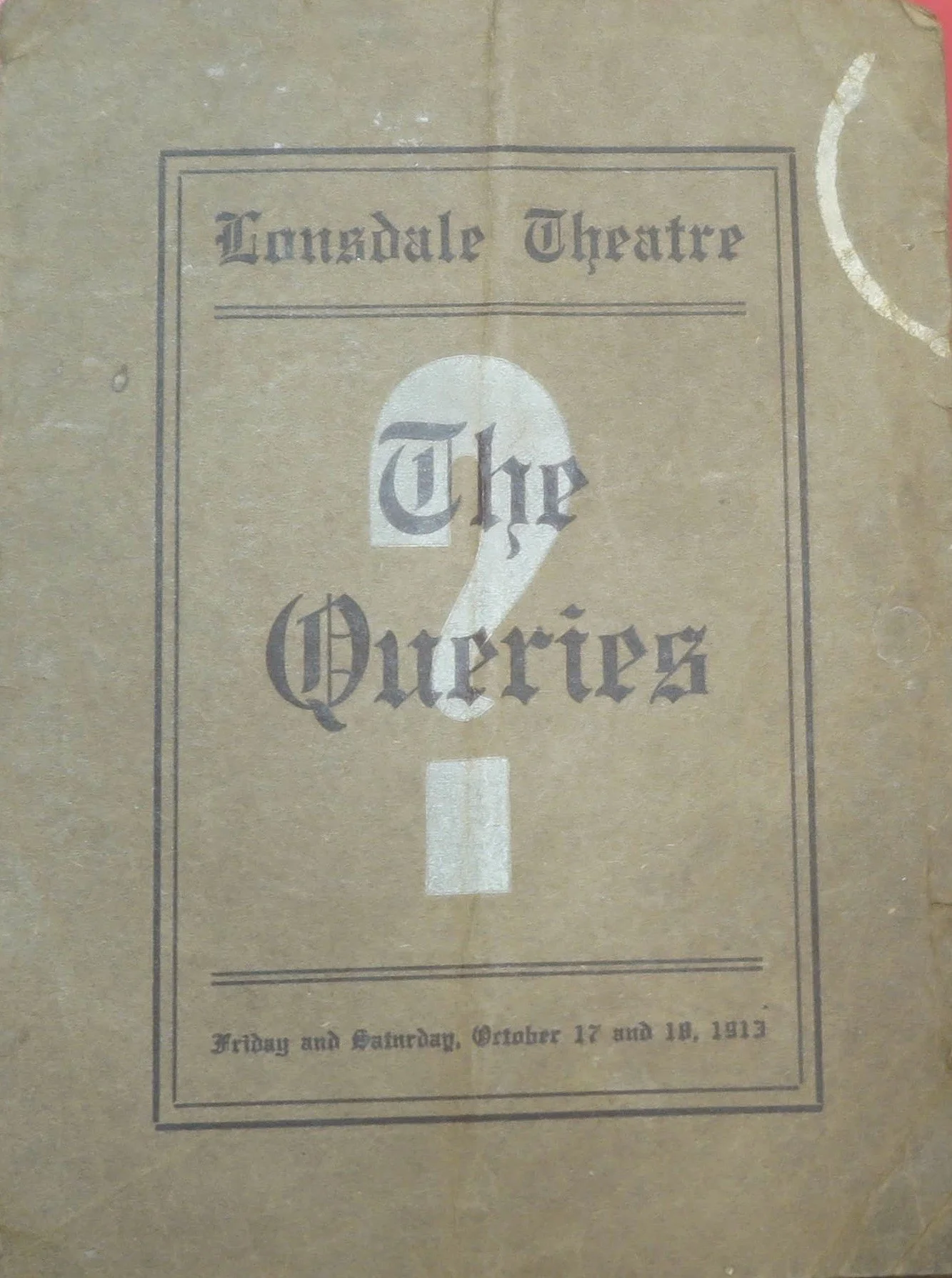
Flyer for The Queries at Lonsdale Theatre, October 1913. General release photograph.
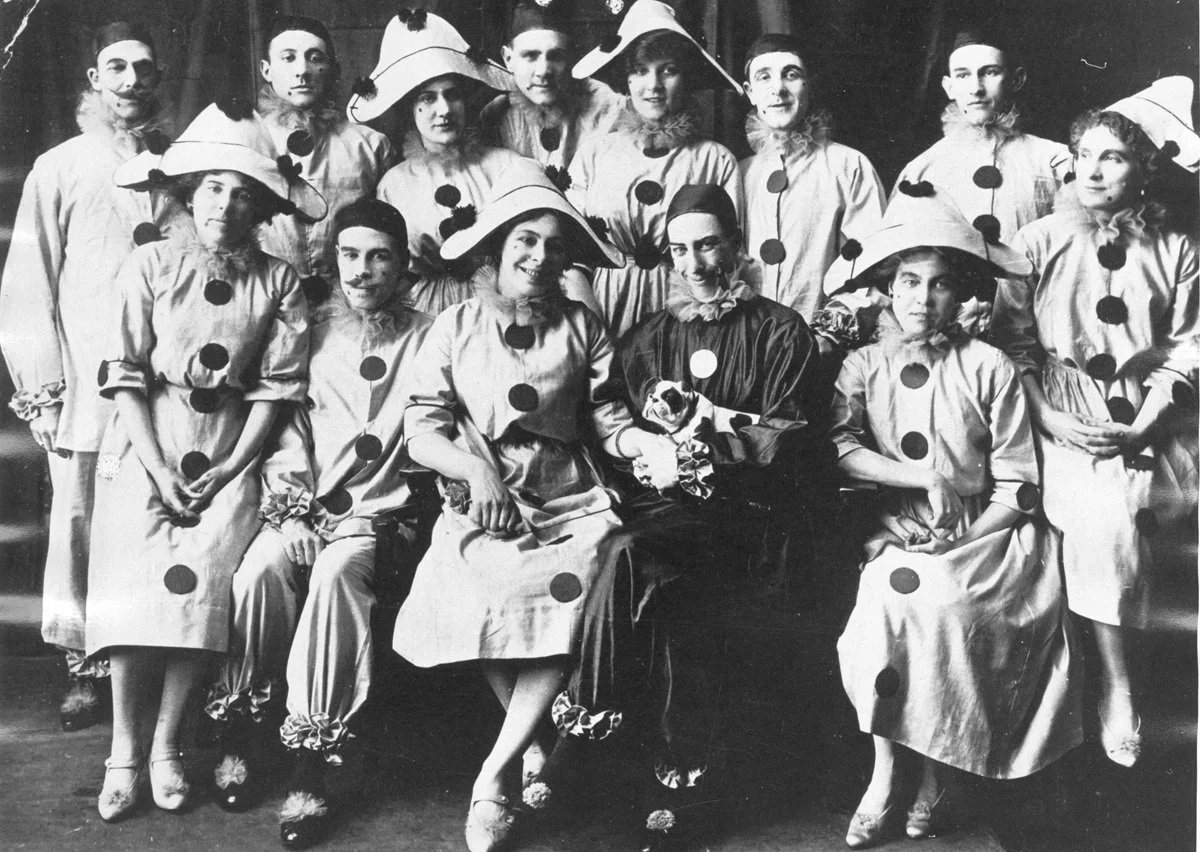
The Queries in 1914. Hilliam in a dark costume. Photograph courtesy of MONOVA Archives, Inv 6341.
Hilliam describes his newly formed ensemble as “dealing topically with all the foibles and problems of North Vancouver life. We sang songs, which I wrote about the street cars, new telephone service and the ferry board, street lighting and how to cope with the black bears that came down from Grouse Mountain and nosed off the lids of our garbage cans overnight.”
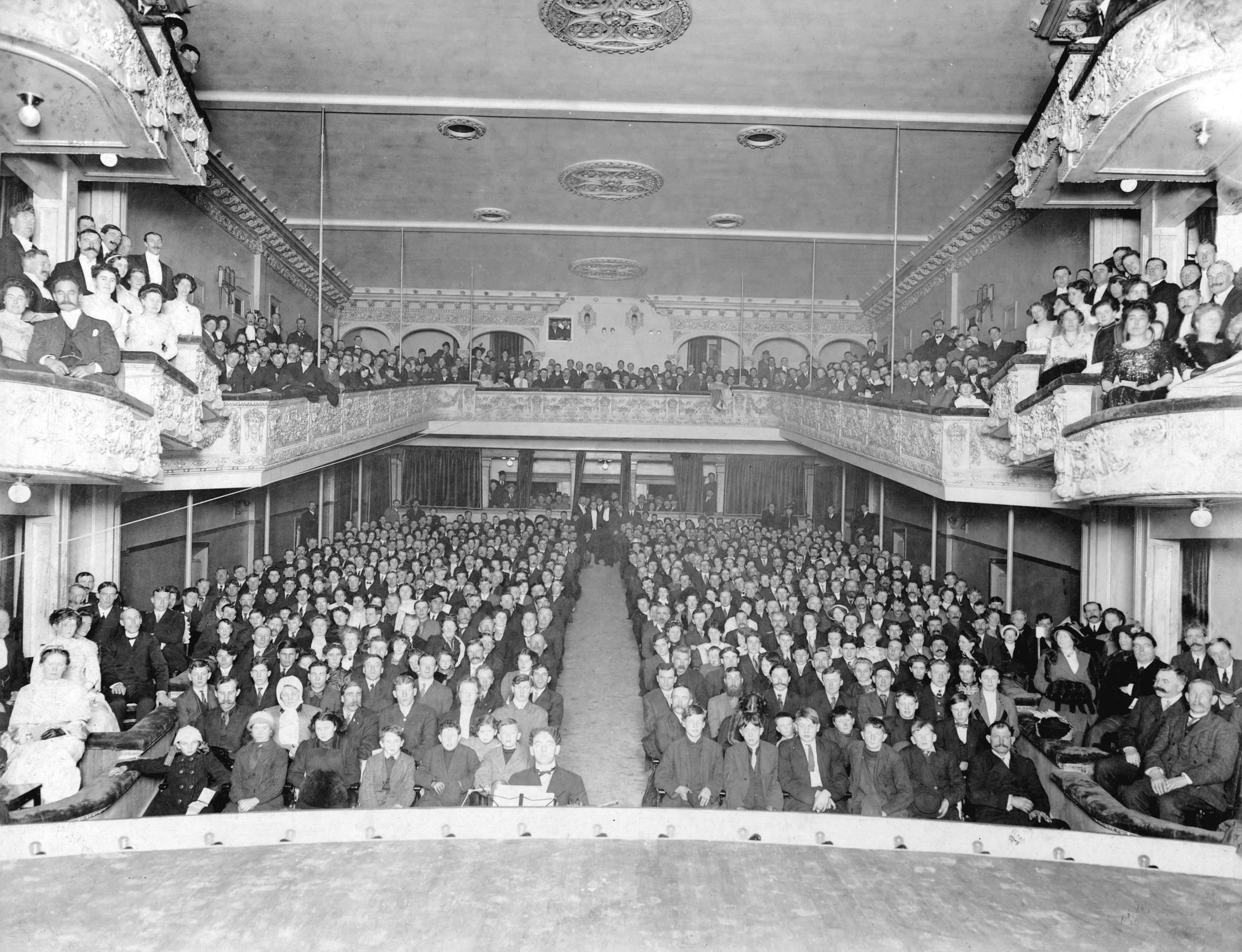
Grand opening night of Lonsdale Theatre, 11th December 1911. Photograph courtesy of MONOVA Archives, Inv 1471.
It was the era of silent movies and one of Hilliam’s early compositions was a foreshadowing of what was to come. Introduced as ‘The Pantorphiascope’ (named after the Pantages and Orpheum Vaudeville acts competing in North America at the time), Hilliam’s skit involved a mime performed in front of the audience whilst synchronised sounds came from a character off stage who shouted and sang with his head in a metal bucket. As Hilliam recalls “It was 12 years pre-Jolson…the effect was quite like the very first experimental talkies when they arrived.”
During the pre-WWI years, North and West Vancouver were in the throes of a real estate boom. Everyone was buying and selling lots in the hope of making a profit. Hilliam participated in the frenzy himself and was inspired to create a character in his show called ‘Looking for lots for Lottie’. He sang the song with The Queries, the chorus going as follows:
“Lottie has lots and lots of lots in all of the most outlandish spots…It takes her a week by motor car to find out where the new ones are. Oh, gee whizz, it’s driving me nearly dotty, scouring the place at a terrible pace looking at lots for Lottie.”
Another song was inspired by a worrisome experience with his mother. Visiting friends, they jumped off the streetcar at the Capilano Road terminus and began a trek up the hill (a route normally undertaken by horse). A dusty motor car was (by exception) making its way up the track causing a passing rider’s horse to shy.
‘On the Capilano Road’ was sung by The Queries mounted on cardboard cut-out horses! A spectacle that had the audience in fits of laughter. The chorus went as follows:
“On the Capilano Road the very first mare we ever strode…my stead deposited its load upon the Capilano Road.”
Hilliam’s first full-scale musical ‘The Belle of Burrard’ had a week’s showing at the Imperial Theatre, Vancouver. As Hilliam later recalled:
“Lottie brought the house down and so did a song ‘Here’s a ho, Vancouver’ with words written by Pauline Johnson.”
Encouraged by his success, Hilliam resigned from The Express to pursue music as a full time living. He gave vocal and piano lessons at his house at 439 7th Street, North Vancouver labelling the location “rather pompously” in his words as a “Conservatoire” before later leasing rooms above the Bank of Hamilton.
In March 1914, at the piano, he performed ‘Here’s a ho, Vancouver’ in front of a captivated audience at The Orpheum, Vancouver. Renowned American baritone, David Bispham was the singer, having been persuaded by Hilliam to perform the role. It was a turning point in Hilliam’s career and one that he was never to forget.
With the first “whisper of war”, Hilliam turned his pen to writing songs that might aid the war effort. Pauline Johnson’s lyrical poem, Autumn’s Orchestra was set to music and given a charity performance in North Vancouver.
Know by the thread of music woven through
This fragile web of cadences I spin,
That I have only caught these songs since you
Voiced them upon your haunting violin.
[Autumn’s Orchestra by Pauline Johnson]
In 1916 Hilliam enlisted with the North Vancouver 6th Company of Field Engineers and was engaged as an entertainer for the troops.
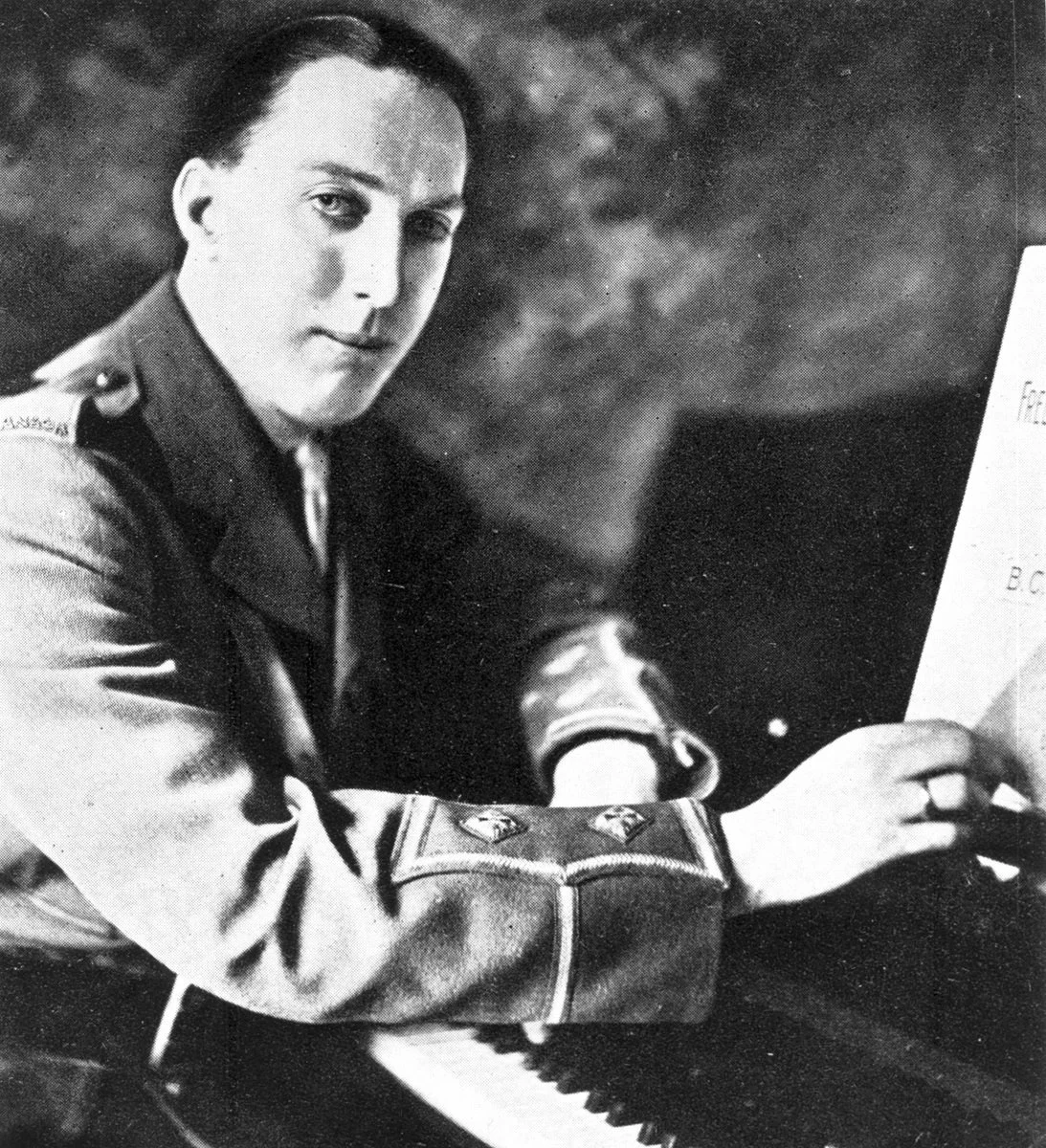
Hilliam in uniform during WW1. Photo courtesy of MONOVA Archives, Inv 6339. Promoted to Lieutenant, Hilliam was given responsibility for recruitment concerts and Canadian camp entertainment for troops stationed in Canada.
At the war’s end, Hilliam left Canada, spending six years in New York. Musical enterprises included ‘Buddies’, a hit Broadway show, before he returned to England and began a partnership with Australian singer, Malcolm McEachern. Flotsam and Jetsam, as they were billed, were a hit on the musical hall and radio circuit for 20 years until McEachern’s death in 1945. Thereafter, Hilliam carried on as Flotsam, founding The Flotsam Follies before revisiting Canada for a solo tour of 33 performances in 1953.
Of course, North Vancouver had changed almost beyond recognition by the time he returned. His regret, made in jest, but with a lashing of wistfulness, was that he had not held onto the real estate lots he had purchased back in the day.
Bentley Collingwood (BC) Hilliam was proud of his initials and retained throughout his life a fondness for the province in which he had gotten his start.
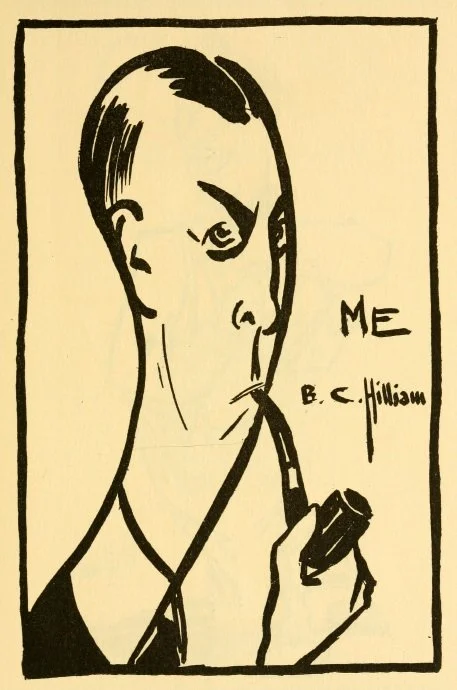
“Me” – a drawing from the book, “Chuckles: This Nonsense”, by J. C. Alden, 1920. Drawing of and by the book’s illustrator, Hilliam.
The house at 439 East 7th Street, North Vancouver where Hilliam and his mother resided remains intact.
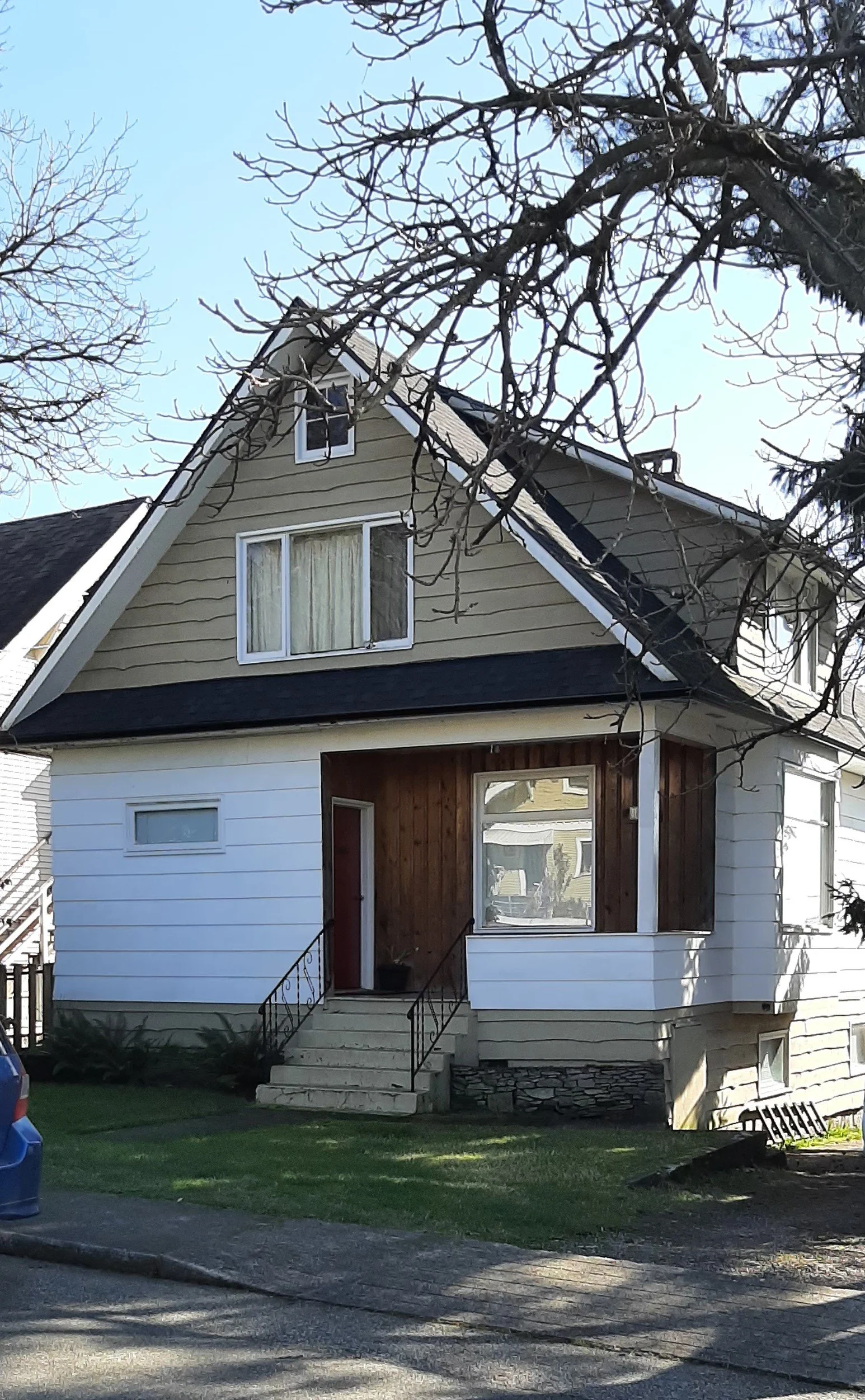
439 East 7th Street, North Vancouver. Photograph courtesy of Paul Haston.
Except where indicated, text and images Copyright @ North Shore Heritage and Paul Haston. All rights reserved. Republication in whole or in part is prohibited without the written consent of the copyright holder.
Acknowledgements
Quotes from BC Hilliam’s 1964 interview with CBC Radio are provided courtesy of the BC Archives.
A shout out goes to the late Sharon Proctor whose notes led me to my research of BC Hilliam.
References
MONOVA, North Vancouver Museum and Archives https://monova.ca/archives/
Newspapers.com https://www.newspapers.com
British Columbia City Directories https://bccd.vpl.ca/