
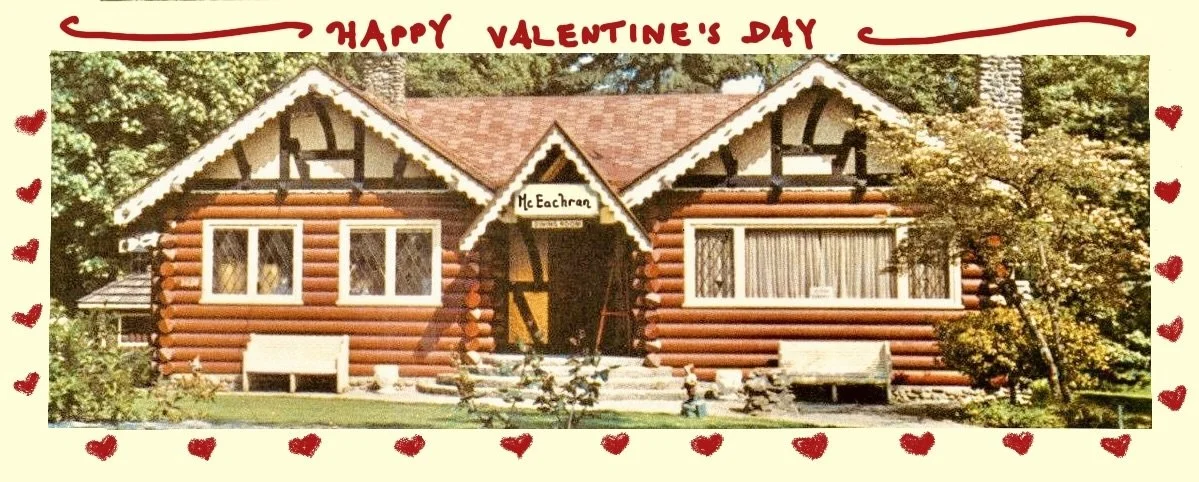
“Here I am alone and I know my Mac loves me, and I love him. After all, loving someone and being loved is wonderful. So in my very most innermost soul, I know my Mac will always be mine and I his.”
If you’ve been to Capilano Suspension Bridge or driven by it, you will likely have noticed a quaint log cabin directly across Capilano Rd from it. Although it was most recently a cafe, and before that, numerous restaurants, it has a history attached to it that is so rich that I'll be writing a two-part post on it. The first one will be focussed on two couples with ties to it, in honour of Valentine’s Day, and the second part will be on the structure itself, as well as its various iterations and a dramatic story related to it.
There are four main players in this intriguing and untraditional love story: Elizabeth (Lili) Rebbeck, Archibald Dunkirk (Mac) McEachran, Lilette Rebbeck and Edward Mahon. All four are inextricably linked to each other and to the Capilano suspension bridge and buildings there.
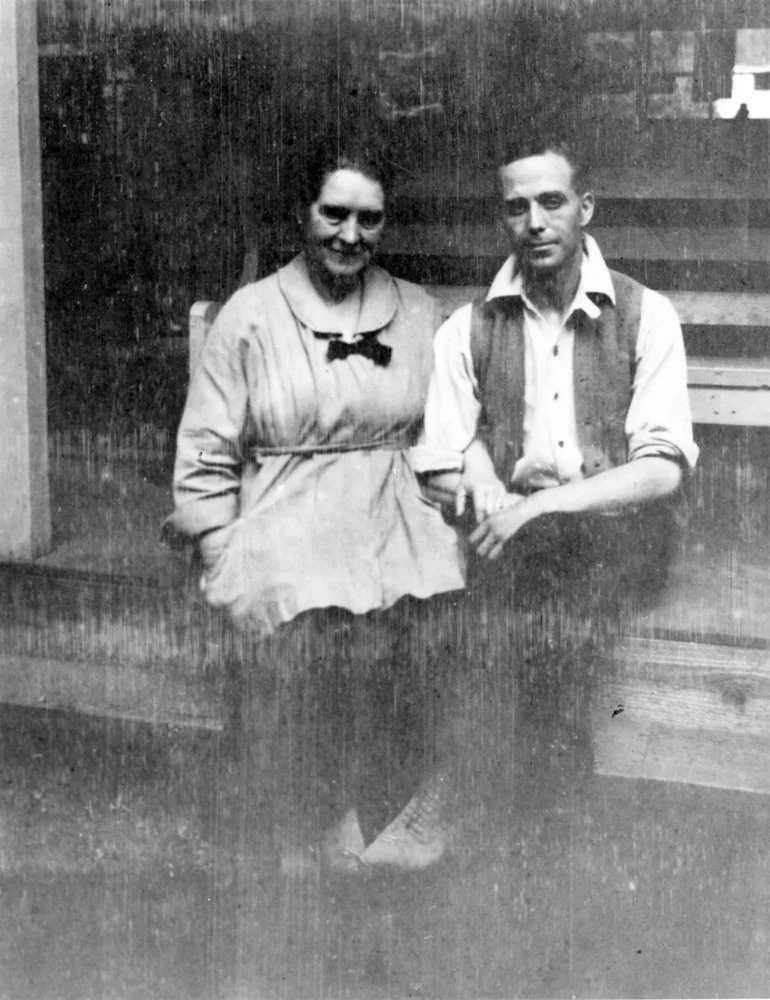
Inventory #151-90 Elizabeth and Mac McEachran on porch of gatehouse ca. 1920.
Photo courtesy of MONOVA: Archives of North Vancouver
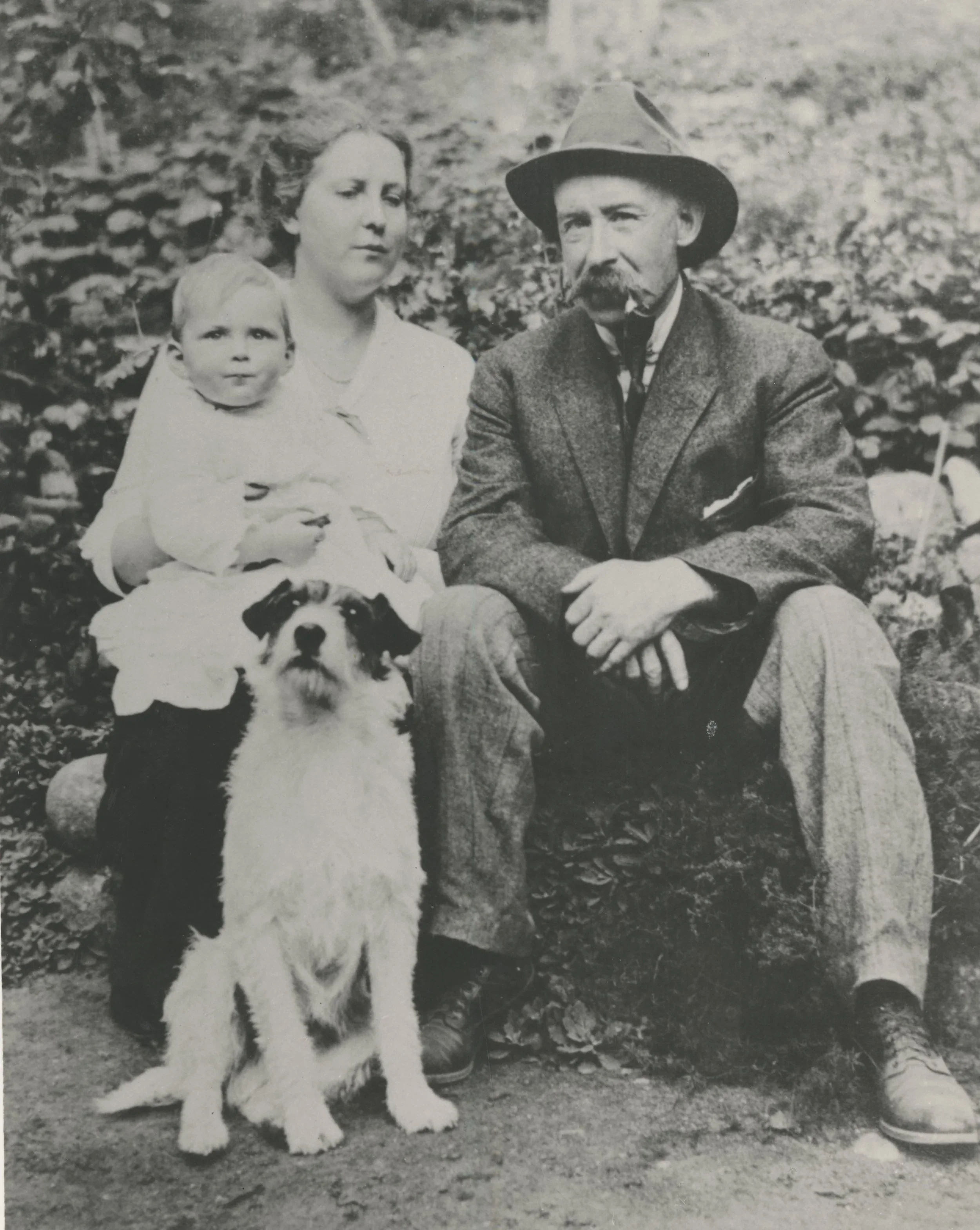
Inventory #151-95 Edward and Lilette Mahon with their son, Bryan and dog in 1914. Photo courtesy of MONOVA: Archives of North Vancouver
One of the leads in the story is a well known North Vancouver pioneer, Edward Mahon, from whom the street honours with his namesake. Edward’s story is full of details, but I’ll stick to the basics as best I can, since the story is more about couples than individuals.
Edward was originally of Irish descent from Rawmarsh, England, and had moved to North Vancouver in 1888. He was very busy with all kinds of property development and industry in the Greater Vancouver area, and became one of the main property developers of North Vancouver in the early 1900s. Although he was building a lot of houses, Mahon was very interested in keeping as much green space as possible and was the founder of the “Green Necklace”, a semi-circle of parks stretching wide across North Vancouver. His love of green space was extended to the Capilano Suspension bridge, which he bought In 1914. He set about improving the property as a tourist attraction, as well as reinforcing the bridge. One of his improvements was a teahouse built by the same Japanese carpenters who built his Spuraway Lodge vacation home on Keith Rd. The building had elements of traditional Japanese architecture, as the Lodge did.
Mahon had been close friends with a colleague, James Knight Rebbeck, a mechanical engineer and naval architect, who lived in Victoria. James was married to Elizabeth (Lili) Rebbeck (nèe Emily Caroline Elizabeth D’Abbadie, of French descent) and they had four children, including a daughter named Lilette. Lili, aside from being a mother was also an author who had written and published two books. One was titled ‘Home of the Dragon’ and was about the two years she had lived in Vietnam with her businessman brother. It was part memoir, part fiction and did so well, it was book of the month. The second book, ‘The Stragglers’ was about a pioneer family in B.C and was edited poorly by a man who didn’t complete the job properly, and Lili, having three young children at home at the time couldn’t do it herself, so it wasn’t as much of a success.
After a prolonged illness with cancer, James passed away in 1910, but before he did, he asked his best friend, Edward Mahon, to make sure his family would be looked after, assuming, we suspect, that Edward would marry his wife after he had passed on. Edward, however, was interested in 21-year-old Lilette, the eldest Rebbeck offspring, courting her and marrying her about a year later, assuring her that her mother would still be looked after.
Lilette was a talented artist who was part of a fortunate group of children who studied art under Emily Carr for a period of time. Lilette created many paintings over the years and kept up her craft throughout her adult life. She was very fond of her time with Carr and said this about her: “We called her Milly. She was a gay and exciting person. Eyes sometimes grey green, sometimes blue grey, thick stubby lashes shading their twinkle, an elusive dimple, piled up brown curls tamed into a bun on top of her head; neat poulter pigeon figure, rare flashes of authority when we became too exuberant. A merry and amusing creature not far removed from ourselves.” ( You can read more about this in this Castlegar News article)
Lilette, married Mahon, despite a 26-year age gap, and the fact that he was her mother’s age. They had a boy, Bryan, who eventually went on to have a distinguished career with Boeing in Seattle.
When Edward Mahon bought the suspension bridge property, he and Lilette had already been married a few years and their son, Bryan was a toddler. Lili and Lilette had moved to the Canyon after James Rebbeck passed away, and lived in a house built right on the cliff of the canyon, although after Edward and Lili were married, they lived in Downtown Vancouver on the corner of Hastings and Burrard, and an interesting little side note - the house was torn down but the site became the place where the Marine Building was built! (This happens to be one of my all-time favourite buildings in Vancouver).
But I digress! I’m attempting to weave the four stories together without getting lost or getting the reader lost! Going back to Lili’s story;
Mahon kept his promise to his friend, James Rebbeck, and to his wife, Lilette, and hired Lili to run the teahouse, and she lived on the property as well. This was a challenging task, especially during the years of WW1, when rationing made it difficult to source food, and when the number of visitors fluctuated hugely from day to day. But she made it work well. She fed many people at the teahouse, whether tourists passing through or locals who ate there as it was nearby their work. One such local was Archibald ( Mac) McEachran. He was originally from Ireland, and, although trained as a civil engineer, fought in Africa during WW1, and was working nearby as a forest ranger after moving to North Vancouver. During this time, he ate frequently at the teahouse and got to know his host, Lili, and they fell in love. Lili (who was nicknamed ‘Betty’ by Mac, was almost 35 years older than him. It’s surmised that they didn’t actually tell each other their ages. It was clear that there was a fairly large gap, but not one that was clearly defined. On their marriage certificate, they seemed to try and close the gap a bit by Mac saying he was a few years older, and Lili saying she was much younger so that the gap was 20 years, when in fact it was about 35 years.
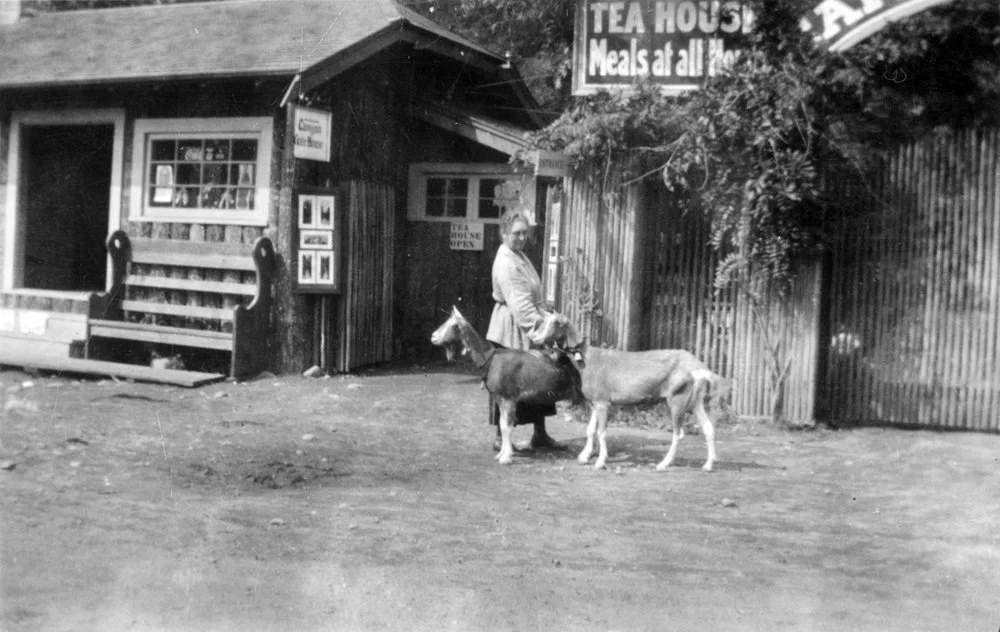
Inventory #151-90. Lili with her goats at the Suspension bridge tea house.
Photo courtesy of MONOVA: Archives of North Vancouver
In essence, Lili married someone closer to her daughter’s age, and her daughter did the reverse, marrying someone closer to her mother’s age! However, from the reading I’ve done, the couples appeared quite compatible, and there seemed to be a lot of love and affection between each couple. There isn’t much mention that anyone close to either couple made much of a fuss about the age gaps, which I think is unusual, but also refreshing.
I mentioned some basic background on this character, Archibald McEachran, or Mac as he was known. But what was he like as a person? What was it about him that made Lili fall for him? He was said to be a kind and caring person, but also quite colourful and even at times, dishonest. He was certainly not a boring individual. Mac and Lili lived in a home somewhere on the west side of the Suspension bridge property. They seemed happy there, although it sounds like the place needed some work. They both worked hard and things were going quite well, aside from being tight for money at times. Then Lili got hit with some surprising and upsetting news. A letter arrived at their home and Lili was the first one to open and read it. It was from Mac’s daughter, Irene. Turns out he had had a child at 18 years old with a 17-year old girl in Ireland 17 years prior, and although they hadn’t lived together, they had gotten married! So the marriage between him and Lili was not actually recognized. After the shock, however, Lili took it in stride and decided they could all live together, as Irene expressed wanting to move to North Vancouver. She had been raised by a great aunt in Ireland and was ready to spread her wings and move to Canada.
She didn’t end up moving in with her dad and step-mother in North Vancouver. She moved to Vancouver, instead. Shortly after, Mac found a place to live in Vancouver and he went to his and Lili’s home in Capilano, abruptly took his things and announced he was leaving the canyon and going to live in Vancouver with his daughter for a while. Lili, on the one hand understood that Mac was making up for lost time with Irene, since he had missed out on raising her, but on the other hand, she didn’t know when he would come back. She was very attached to Mac and it was hard on her. There are a number of letters written to her son, Waller, in the Capilano Suspension bridge archival collection, and she wrote in one of them that before leaving, Mac said “ Betty, I will come and see you. We will be together again.” She then wrote “ It’s been a month since he’s been gone”. It must have been exceedingly difficult to be supportive while also hoping her husband would make good on his word and come back to her. He had already left once before for a prolonged period when they were struggling financially to buy rum in the West Indies to sell across the border during prohibition! But this was somehow different!
Fortunately, Mac did return and decided to build them a log cottage across from the bridge. He purchased 20 acres of land from the Keith family after which Keith Rd takes its name. The newspaper at the time wrote about the sale and said that Mac intended to have a poultry farm on it. I don't know if any of this came about in the end.
The house design was full of loving and homey details, some of which Lili wrote about to her adult son.
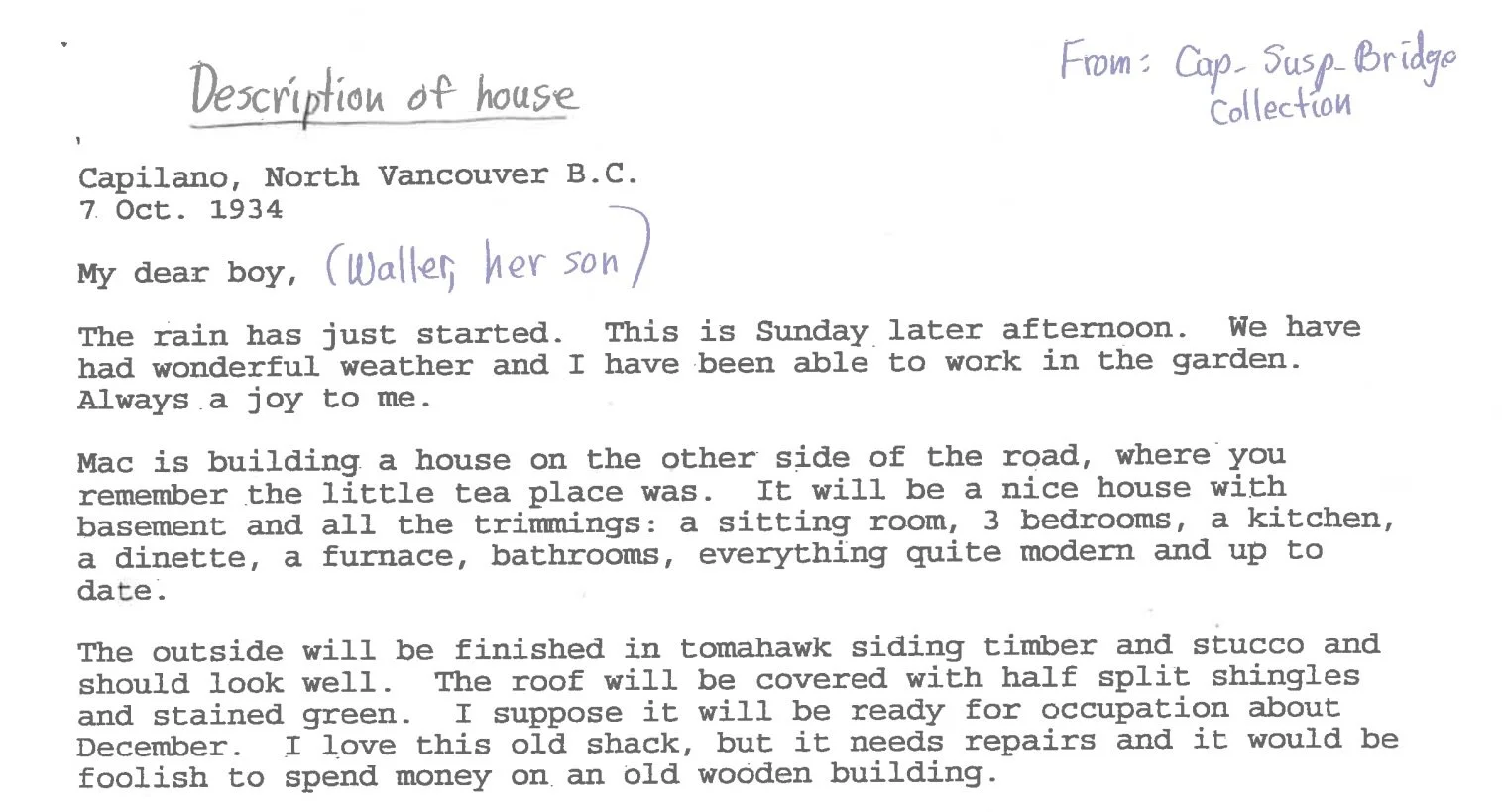
Excerpts from letters written by Lili McEachran to her son, Waller.
Courtesy of Judy Watten and Sharon Proctor from MONOVA:Archives of North Vancouver
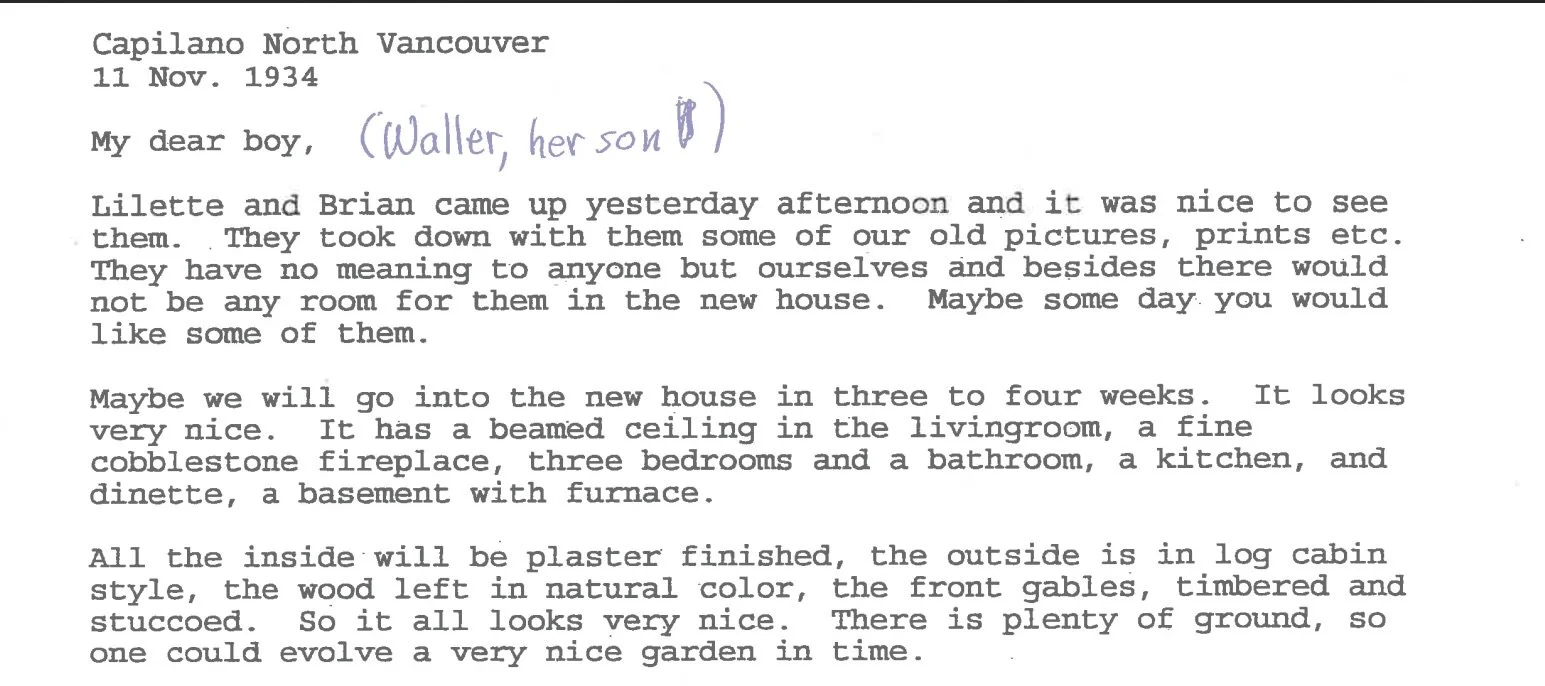
Excerpts from letters written by Lili McEachran to her son, Waller.
Courtesy of Judy Watten and Sharon Proctor from MONOVA:Archives of North Vancouver
Tragically, it wasn’t ready by December, and Lili ended up in the hospital with heart issues in February of 1935 and died before she and Mac could ever live in the home together. She was 71 when she passed. From the way she wrote, it appears she had no idea she would pass away any time soon. The letters are a poignant window into how much she was looking forward to living there with him. However, Mac and his daughter did end up living there for awhile and it eventually became known as McEachran House.
Mac took over running the Suspension bridge from Edward after Lili’s death and was its proprietor until 1945 when he sold it. He moved to California with his daughter and lived there until 1965 when he re-married and died, tragically, on his honeymoon when he fell off a horse in Mexico. His daughter remained in California until her death in 1997.
Edward only lived for a couple of years after Lili’s death, and he died in Vancouver in 1937. During and after she was widowed, Lilette continued living in Vancouver. Her son, Bryan was grown by this time and she was busy with a heavy involvement with the Vancouver School Board as well as some political activities. She ran for city council and Federal Parliament (although didn’t win any seats) and served as president for the B.C. Parent-Teacher Federation, the Vancouver Parent Teacher council and president of the B.C. School Trustees Association. She still had a love for art and took four years of studies in the 1940s at the Vancouver School of Art. She moved to Seattle in 1953 and died there three years later.
Both couples lived very full lives. And all four individuals were strong people with many interests and a zest for life. They form a big part of the history of North Vancouver, although I didn’t realise until Jennifer Clay was looking into them ahead of me writing this article, how curiously they were all intertwined.
I’d like to leave this story with a couple of sweeping, romantic quotes. The first was something Mac said to Lili after returning from his rum trip, “I never want to leave you again. I care too much for you”.
And when Mac was away from Lili, living in Vancouver, she remembered him telling her this, and she wrote this in response: “Here I am alone and I know my Mac loves me, and I love him. After all, loving someone and being loved is wonderful. So in my very most innermost soul, I know my Mac will always be mine and I his.”
The next blog post won’t be mine, but when I write my next one it’ll be more on the McEachran house, so stay tuned!
There are many thanks to be said for the research I used in this post.
The late Sharon Proctor researched the Rebbeck family extensively, for an article she wrote in 2012 for the North Vancouver Museum and Archives article ‘The House that Mac Built'“. She wrote to Lili’s granddaughter, Judy Watten in 2010, and learned a lot of first-hand knowledge about the family as Judy shared her story. This post wouldn’t have been possible without all that research.
Jennifer Clay, although she asked not to be credited, I need to thank, as she went to the MONOVA archives and spent a lot of time pulling out pages of wonderful documents for me to draw my story from. The story would be so much less warm and colourful without all those pages.
Georgia Twiss should also be thanked, as she was the staff member who found all the documents for Jennifer and scanned them at the Archives.
References:
newspapers.com, capbridge.com, castelgarnews.com, westendvancouver.wordpress.com, changingvancouver.wordpress.com, North Shore Heritage (Jennifer Clay, Spuraway Gem article)
*Note: The postcard is a mock-up Valentine postcard. I used a postcard I bought of the McEachran house when it was the Chelsea Restaurant and modified it as a re-imagining of Mac and Lili living in the home together.