
In February, 1929, Warren Leach Clegg, a British immigrant, received the approval to build a house at 1591 Haywood. It was completed in 5 short months for the princely sum of $3000. Warren, his wife Margaret and their 4 children moved in on July 12, 1929. Dodging the stock market crash by mere months, it is possible that had they waited to build, the house might have been a lot smaller or less ornate or might never have been built at all.
Ninety-three years later, in February, 2022, the board of North Shore Heritage stood on the front lawn with the new owners, Meghan and Darrin DeCosta, contemplating the next phase of life for this historically significant home. This would involve the restoration of the building and the addition of gentle density in the form of a garden suite and a rental above the garage. Construction took 13 months and cost just a little more (!) than the original $3000, with the end-result being the retention and legal protection of this charming Craftsman home. While this sounds easy, none of it would have happened without the vision, the persistence, the creativity and the dedication of the DeCostas to the project and their goals of retaining historically significant features while upgrading to a more environmentally sustainable home. It is a project worth sharing! And if you read beyond that, I also snuck in some Clegg family history!
Good Bones
When the DeCostas purchased the house in 2021, it was clear that the house had “good bones”, due to its solid Craftsman design, the high quality of building materials and the loving care bestowed on it by the Clegg family, the Forsyth family and eventually the Flemming family who cared for it the longest, from 1964-2021.
Most of the home’s original exterior features had been retained over the years, but the interior had been heavily modified. Original features included the interior doors, front door with leaded glass windows, some sash windows in the dormers and wide wooden-lapped siding along with the covered front porch, open roof soffits, triangular eave brackets, exposed rafter ends, and the unusual flared eaves.
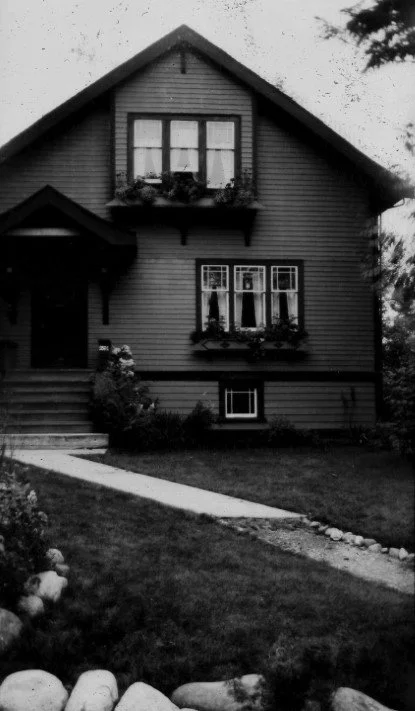
Clegg House circa 1930. Courtesy of the Clegg family via Darrin DeCosta.
Over time, some changes were made including the installation of 1950’s-style wood windows, and the replacement of the front window with a bay window.
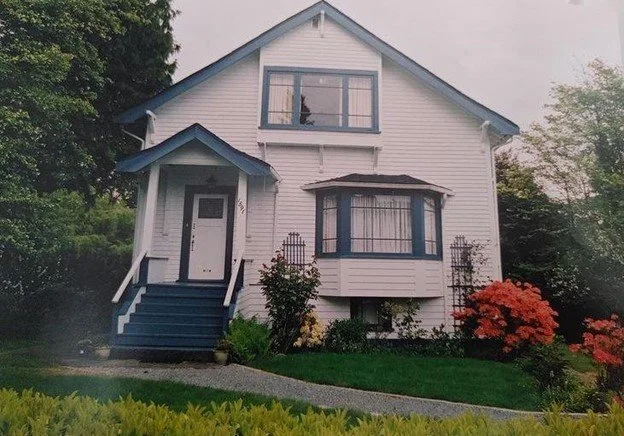
Clegg House circa 1970. Courtesy of the Clegg family via Darrin DeCosta.
The photo below was taken in 2021 when the DeCostas purchased it. With the exception of the removal of the ornate windows planters, it had not changed much since the 1970’s.
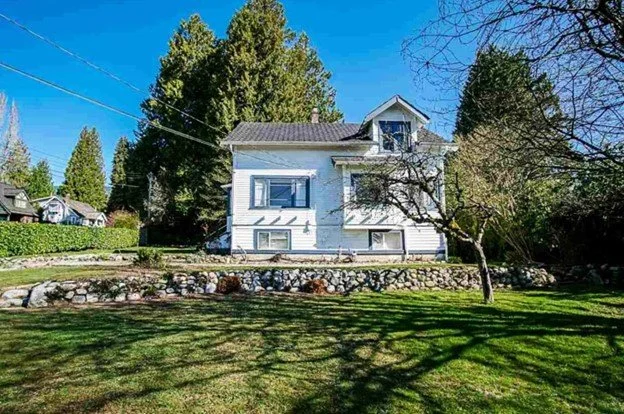
Clegg House. 2021. Courtesy of Darrin DeCosta.
The Restoration and Renovation of the Clegg House
Although the DeCosta family purchased a house with “good bones”, the tasks at hand to bring the home into the 21st century were complex, time consuming, expensive and stressful. This involved architectural designs (and re-designs), negotiations with the District of West Vancouver, consultations with the neighbours, public hearings, and establishing a team of contractors and trades who understand old houses. But 3 years after they acquired the Clegg House, the DeCosta’s had a building permit in hand and an agreement with the District to restore and legally protect the Clegg House through a Heritage Revitalization Agreement (HRA) and Heritage Conservation Agreement (HCA).
The Clegg House project goals were three-fold:
Remove unsympathetic modifications and replace them with features or materials that are true to the original design
Upgrade some of the original design features to meet or exceed the current building code requirements and
Make the house more environmentally sustainable to withstand our new climate realities
Below are descriptions and photos of some of the bigger activities the DeCosta’s undertook during their 13-month project.
Structural Improvements – Bottom to Top
The original house, in early 20th century style, was set on, but not secured to the foundation. As part of the renovation, a new foundation was constructed, the house was bolted and structural shear panels were added to prevent racking and meet seismic standards. The roof structure was upgraded as well as roof systems of this vintage often suffered from sagging “saddleback” rooflines due to insufficient structure in the ridge and eventual rafter spread. The original douglas fir floor joists were in amazing condition and were sistered with additional material to ensure the house could withstand whatever mother nature might throw at her.
Window Restoration – Newly built in Original Design
Since the majority of the original windows had been removed, and replaced with 1950’s single pane wood windows, one of the biggest projects was to have new double-glazed double hung sash style wood windows custom-built in the style of original windows. These were built by Marvin Window and Door and installed by North Shore Door
Upgrading Heritage Windows – Restoring and Leak-proofing
As one of the character-defining elements identified during the heritage assessment, the original double hung windows in the dormers needed to be preserved. The sashes themselves were in fine condition but had to be stripped and prepared for new paint. Darrin and their painter, Masa, carefully stripped away 100 years of paint, taking the sashes back to bare wood, and then re-primed and painted the original windows and sashes for re-installation. Numerous methods were tried, but in the end, Dumond Easy Strip Red was the product of choice.
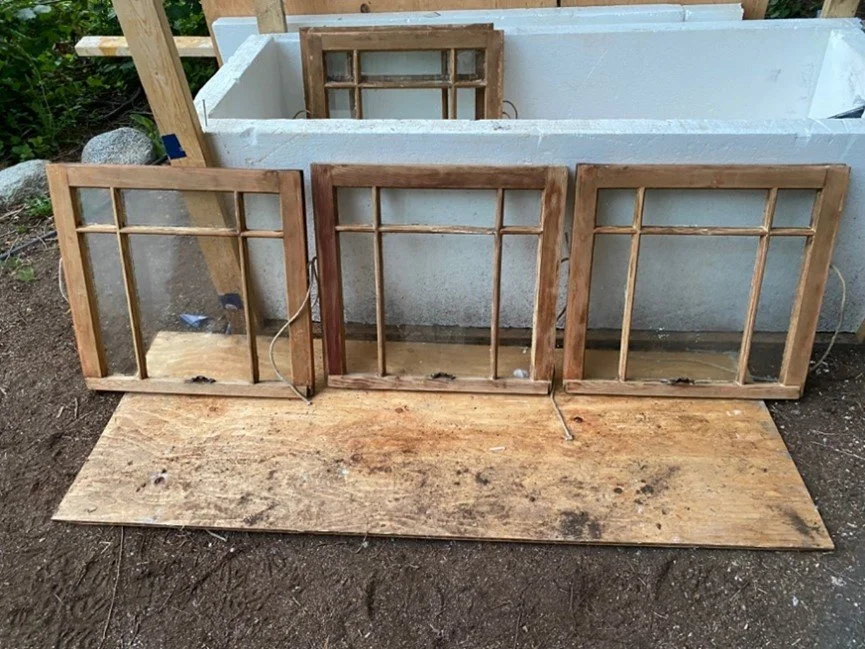
Original wood windows, stripped to bare wood. Photo courtesy of Darrin DeCosta.
Double-hung windows are notoriously drafty because of the large weight pockets that surround each window and poorly-fitting sashes in windows. Darrin decided to partially address this issue through the use of spring-loaded counter balances made by Pullman Manufacturing which would replace the original heavy iron weights that are traditionally found in pockets on either side of the window. These sash balances have been manufactured by Pullman since 1886 and used extensively on the East Coast. After the installation, insulation was added to the pockets that were no longer in use.
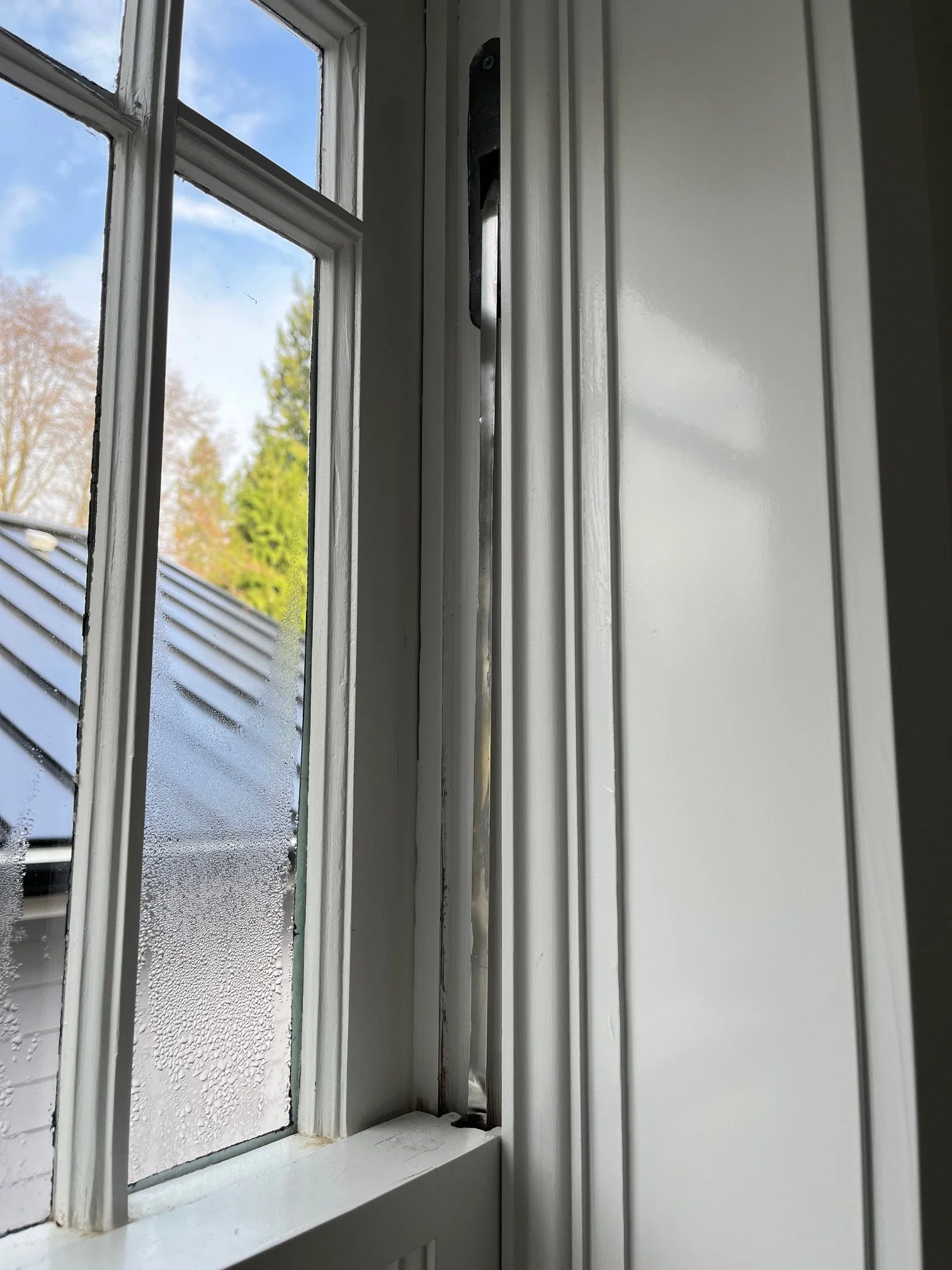
Pullman spring-loaded counter balances. Photo by Jennifer Clay.
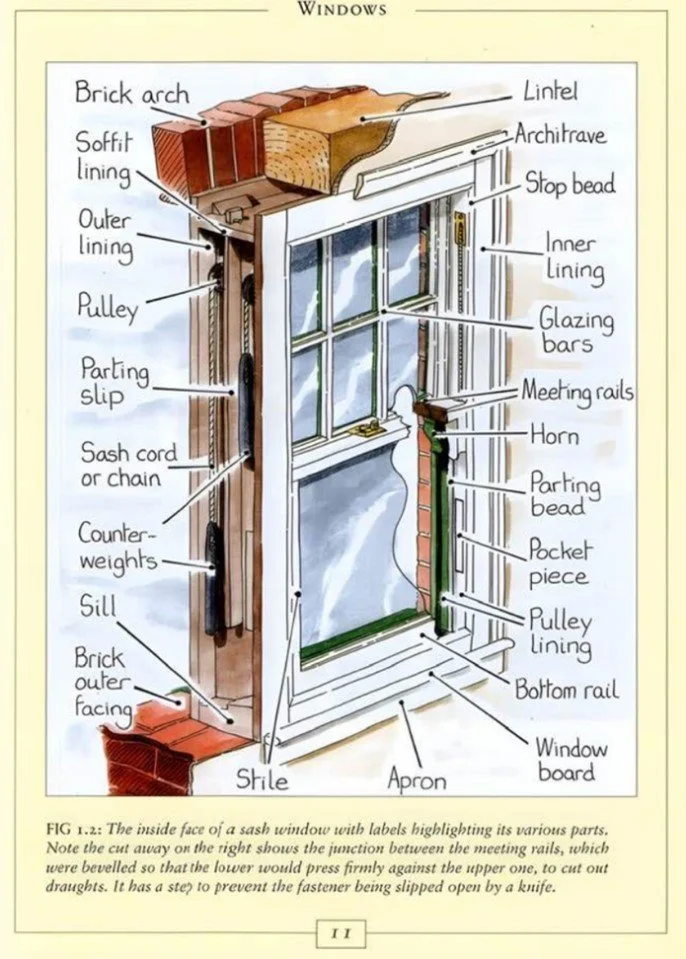
Diagram of original window design showing the pocket which traditionally held the iron weights. These have been insulated in the Clegg House as they are no longer needed.
In addition, Darrin installed spring bronze flashings in the channels where the windows slide, which in older houses, is another notorious source of air leakage. These were sourced from Kilian Hardware and installed by their heritage carpentry specialist, Wyatt Harvey. Air and water leakage, even in our wind driven rainy winters, has been significantly reduced.
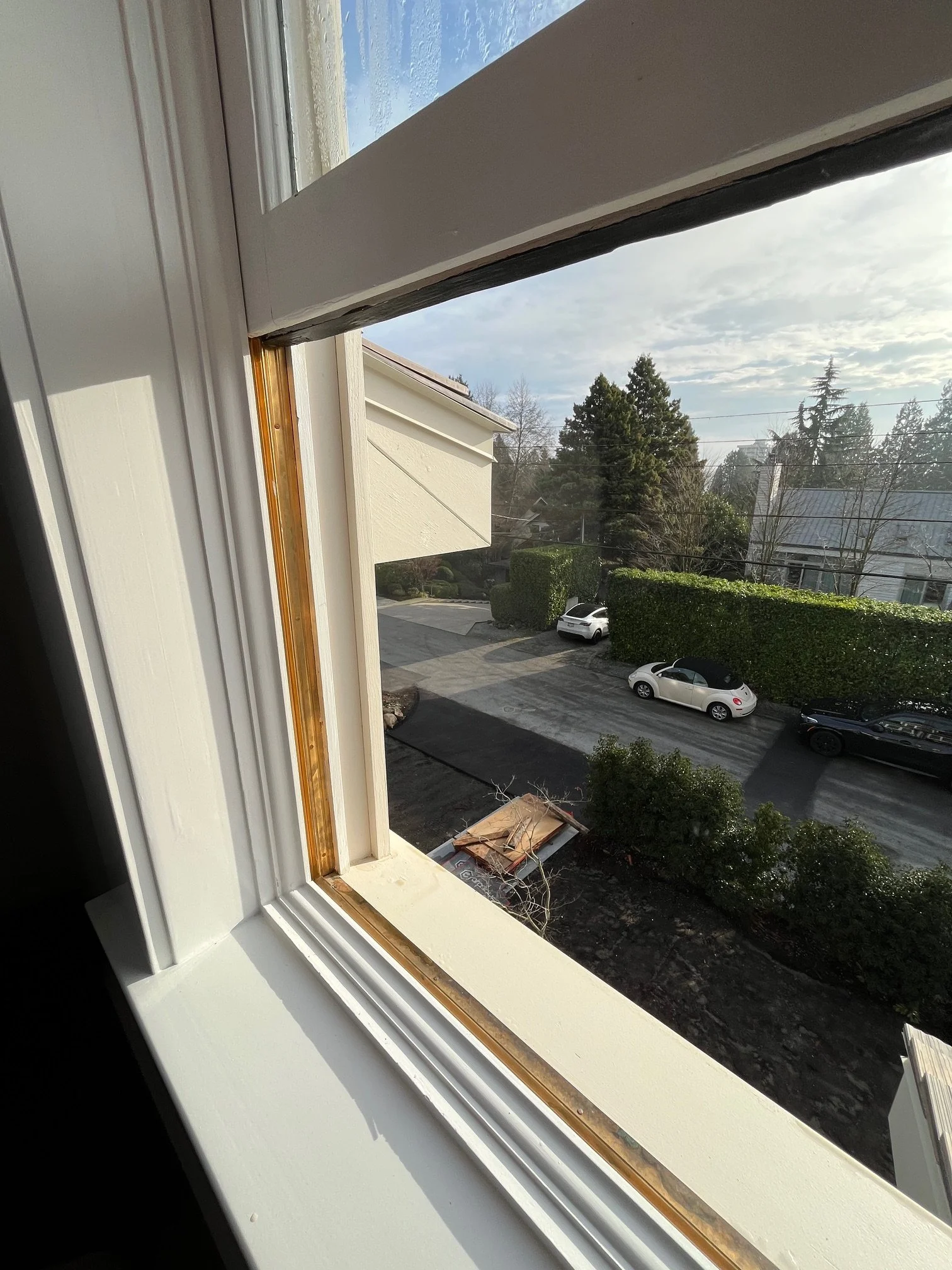
Spring bronze flashings are now installed in the Clegg House, reduced air leakage. Photo by Jennifer Clay.
Original Interior and Exterior Doors – Strip and Paint and Restore Hardware
The original doors of the main and upper levels of the Clegg house were in good condition, but had decades of paint on them. In addition, the interior door hardware with original crystal knobs was there and generally in good repair. Darrin and Masa again stripped and re-painted each door, and the front door was repaired to return it to mortice lock operation, and then Darrin re-cut keys for each existing mortice lock to allow them to work again as intended before re-install. The hardware was stripped using the boiling water method.
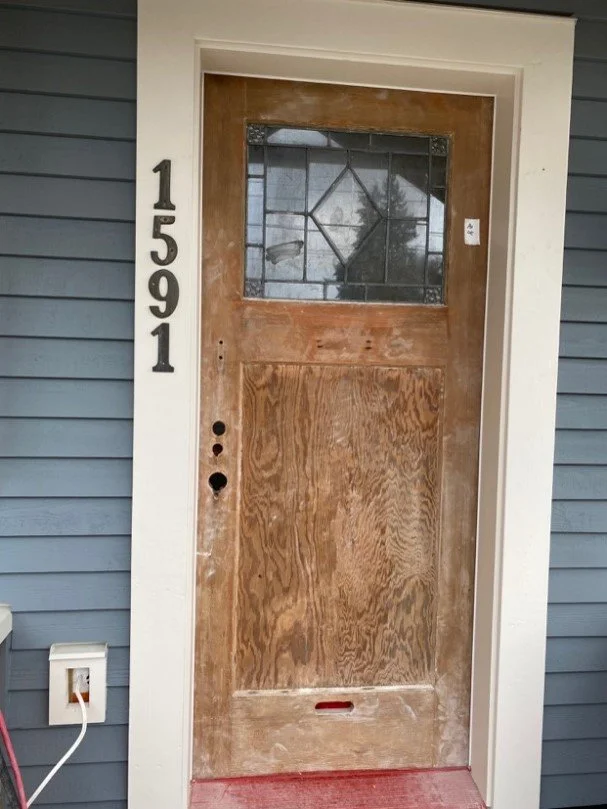
Front Door, stripped of paint and awaiting new mortice lock hardware. Photo courtesy of Darrin DeCosta.
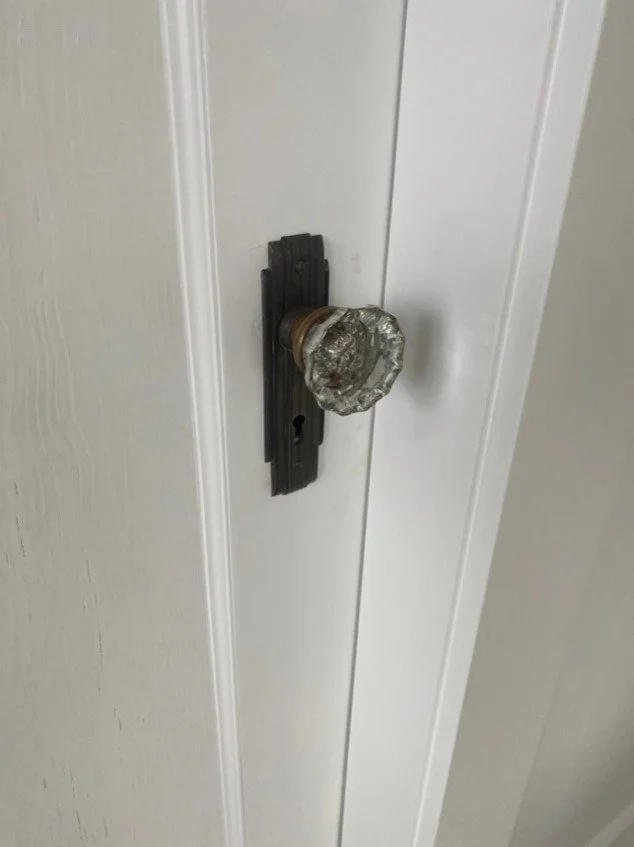
Original interior door hardware. Photo courtesy of Darrin DeCosta.
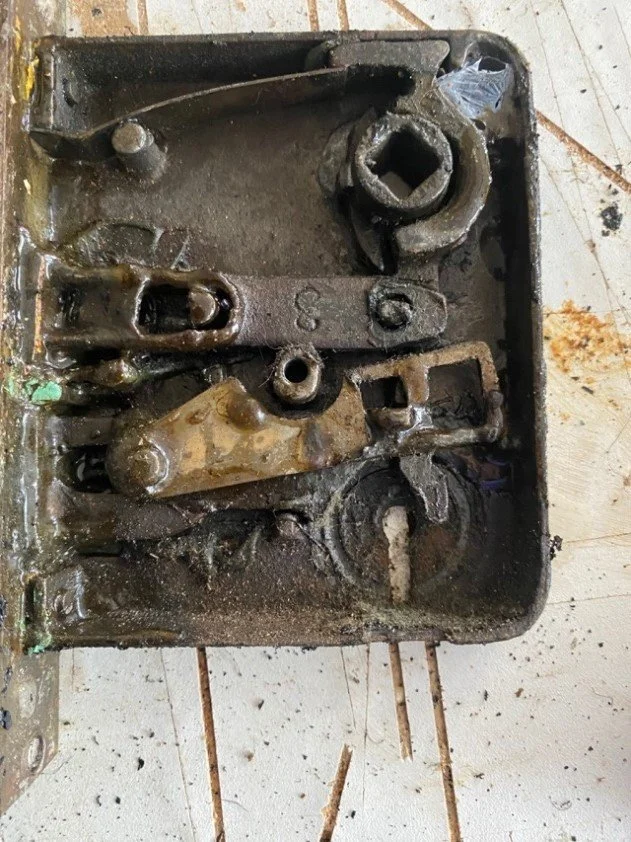
Mortice Lock Hardware. Photo courtesy of Darrin DeCosta.
Building Envelope - Before
Before project commencement, the DeCosta’s had the house air-leakage tested using a blower door test. The house scored 8.2 ACH50, or 8.2 air exchanges per hour at 50 pascals of pressure. The house was wildly inefficient, but on the positive side, all these air exchanges resulted in wall and roof assemblies that could dry out when they got wet. Despite water-staining on the inside of framing and sheathing, the building had almost no rot. The DeCosta’s wanted to tighten things up but wanted to ensure that they weren’t creating a building decay issue.
Saying No to Half Measures and Retrofits with Tyvek, Batt and Poly
Part 9 of the BC Building Code allows for walls to be enveloped in plastic, Tyvek (plastic) on the exterior wall, clear plastic as a vapour barrier under the drywall and non-permeable roofing underlayment. Getting the building air-tight is important, however these materials/ standard assemblies can trap water as well as water vapour in the wall and roof assemblies if and when things get wet. Old houses in our climate are fine as-is, but unfortunately, if you try to retrofit half-way, you’ll likely end up with a building rot problem It’s a delicate balance!
Long Term Roof and Wall Treatments – New Gold Standard
For the roof, the DeCostas installed an underlayment of Proclima solixex adhero 3000, a vapor permeable product, a 3/8 entangled mesh drainage mat, and then went with Davinci synthetic cedar shakes as the roofing material for the main house. The Davinci product looks like a traditional cedar shake roof but is warrantied for 50 years and requires no maintenance. In the roof assembly, the DeCostas added rockwool insulation between the rafters and used Intello plus smart vapour retarder sealed with Tescon Vana tape at every penetration.
For the walls, the process was much more complex. The original water resistive barrier (WRB) layer was tarpaper and had completely failed. The decision was made to install a new vapor permeable WRB that would shed bulk water, and prevent air leakage, but allow vapour to pass through to provide maximum insulative value while allowing moisture to flow. This involved many more layers than were present in the original structure including from outside to inside.
Wide lapped cedar siding
Rain screen
WrapShield Peel and Stick vapour permeable WRB replacing tarpaper
Original shiplap sheathing
Original Framing
Rockwool insulation
Intello plus smart vapour retarder sealed with Tescon Vana tape at every penetration
Drywall
Darrin believes that the resulting wall assembly will last for the next 100 years. It provides a drainage plane for bulk water, allows moisture to escape and improves the air-tightness to 2.25 ACH50, which is better than current code.
As a side note to this section, once the building was sealed tightly, it was necessary to mechanically ventilate the space so Heat Recovery Ventilators were installed. According to Darrin, they are about 75% efficient at capturing the heat from the stale indoor air and passing it into the fresh outdoor air. The family’s energy consumption has decreased by 75%.
Window Boxes – A Nod to the Past
One of the loveliest things that the DeCostas did was to duplicate the original design of the window boxes, as seen in the 1930 photo at the beginning of this article..
The flower boxes were mounted on the exterior of the house on flower box studs, a feature common in Craftsman style construction. Unfortunately, the old flower box studs were in poor condition and so new studs were patterned and cut, using a repurposed 100-year old Douglas Fir structural beam, which was originally supporting the main floor of the house.
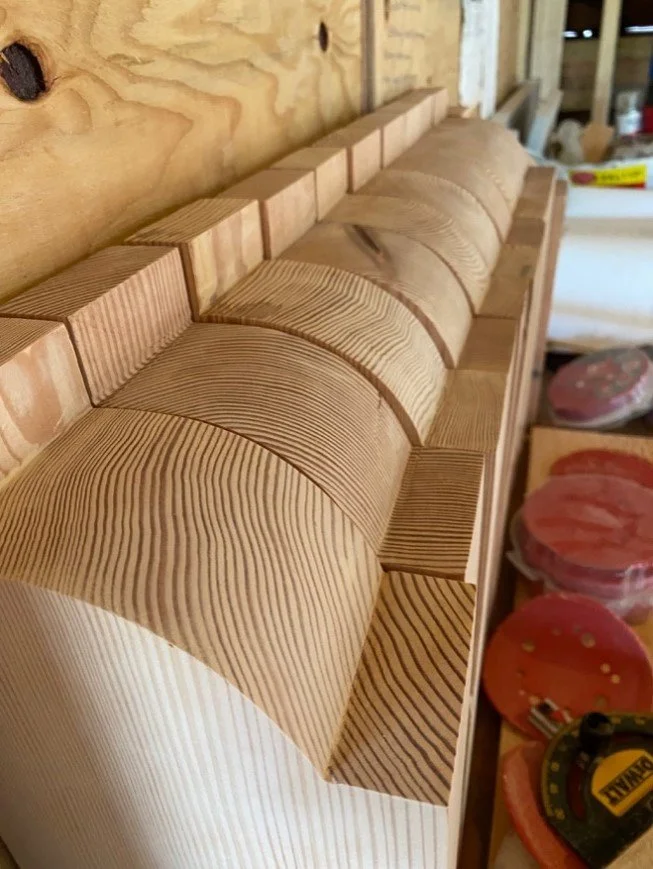
Newly cut flower box studs, fashioned after original flower box studs. Photo courtesy of Darrin DeCosta.
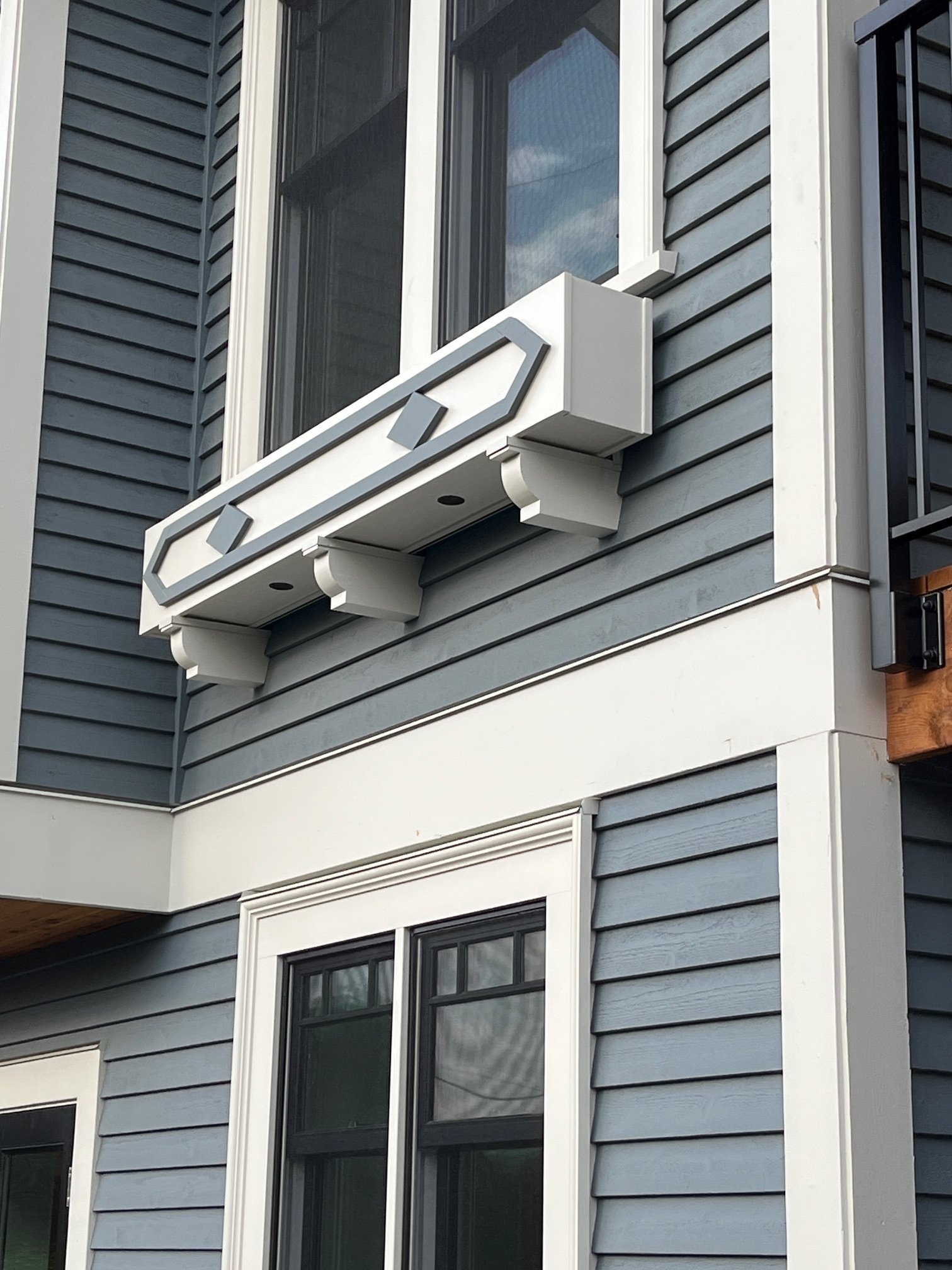
New flower boxes with a design patterned after the original 1930 window boxes. Photo by Jennifer Clay.
Back Deck and Porches – An Exercise in Sustainability
One of the biggest exterior projects was building a covered deck off the back of the house. In a nod to sustainability and sentimentality, the floors were made of wood milled from a large Cedar tree from the property. The sawyer, Ross O’Donnell did an amazing job of maximizing the material and every deck and porch on the property is clad in this beautiful clear cedar. The DeCostas took Ross’ rough lumber and planed and sanded every piece before applying the finish and handing it to the carpenters for install. The cedar tree was new growth and approximately 120 years old based on the growth ring count. The DeCosta’s estimate that this tree was just a sapling in 1912, the year the property was originally subdivided after timber harvesting.
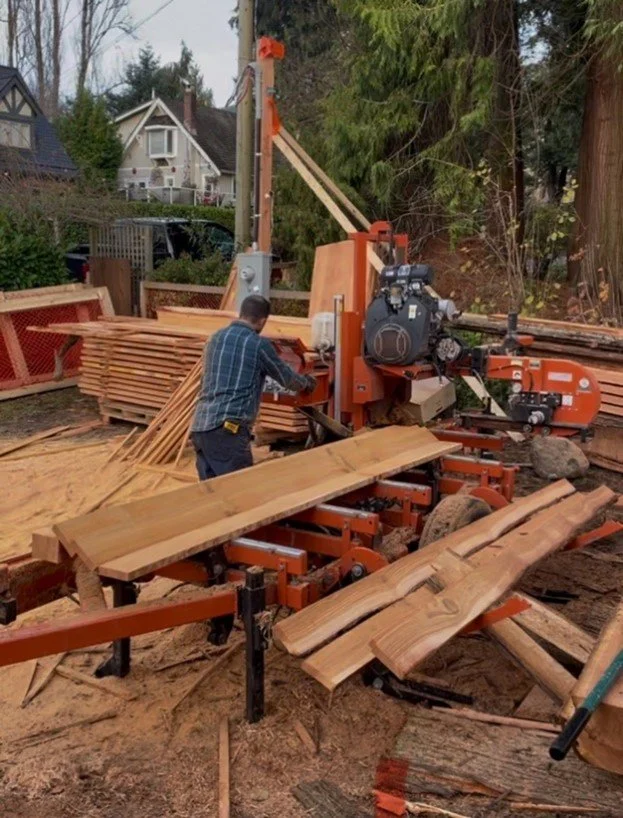
A Cedar tree from the site was milled for use on all the decks and porches of the restored Clegg House. Photo courtesy of Darrin DeCosta.
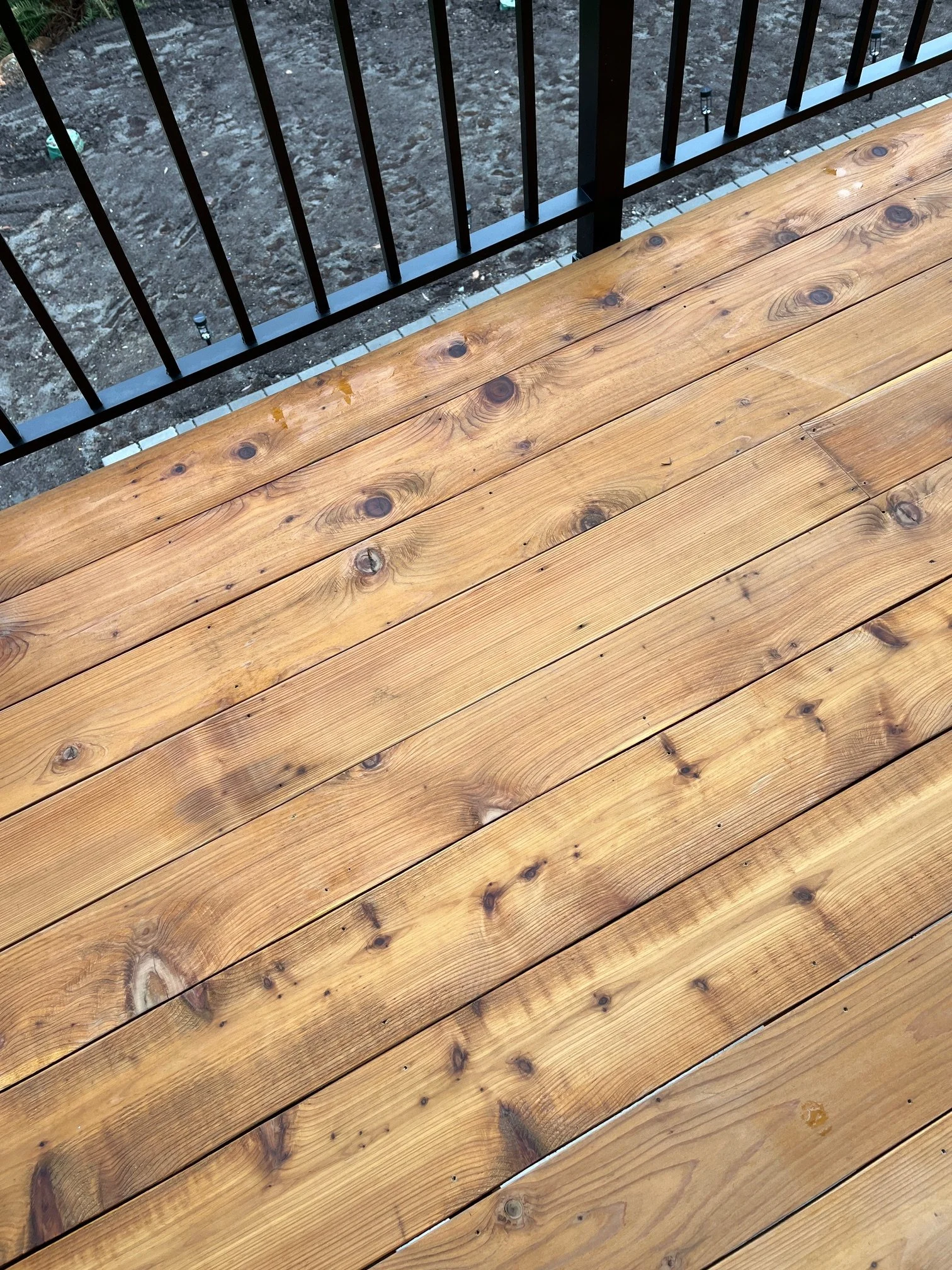
New back deck made from wood milled from a Cedar tree on the lot. Photo by Jennifer Clay.
The DeCosta’s were also able to re-purpose the original 2x4 Douglas Fir rafters that were replaced during the roof structure rebuild. Each twenty-four foot stick was de-nailed, planed, sanded and then installed in all the exposed rafter tail locations and on every porch. The biggest challenge was getting the nails out as this old-growth Douglas Fir was hard and tight, with 20-40 growth rings per inch.
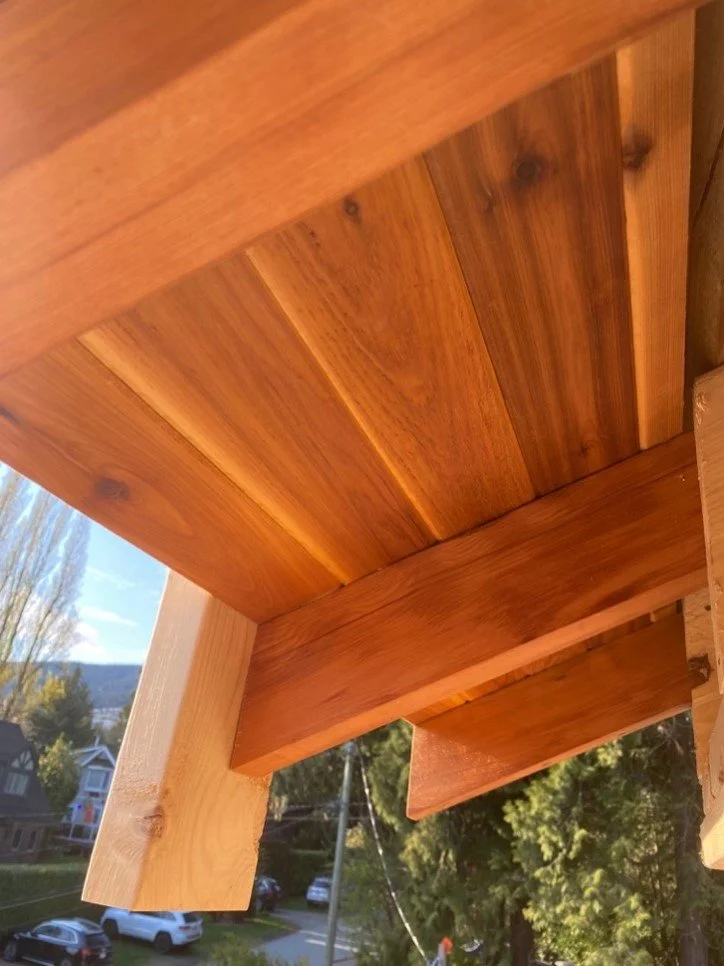
Original Douglas Fir Roof Rafters repurposed for use on the underside of one of the porches on the restored Clegg House. Photo courtesy of Darrin DeCosta.
Even an old Dogwood tree that was cut down was repurposed. Dick Clegg, the grandson of Warren and Margaret Clegg, created beautiful wooden bowls from this wood.
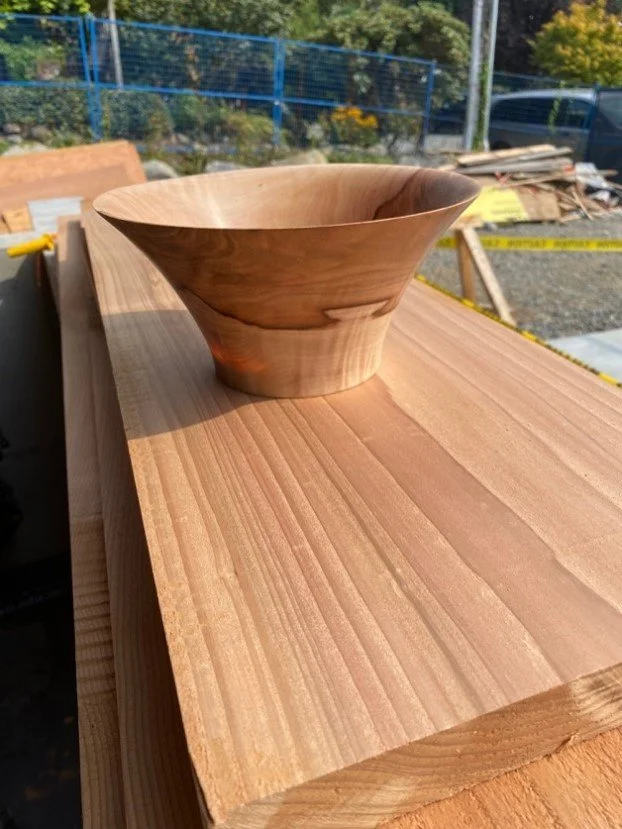
Dick Clegg’s wood bowl, made from a Dogwood tree from the property. Photo courtesy of Darrin DeCosta.
New Spaces – Giving them a Heritage Touch
Although this article is about the restoration of the heritage home, I have to mention that the DeCostas took their practice of repurposing materials into the newly built garden suite and rental above the garage.
In the garden suite, you will find a door that Darrin sourced from the Allen Residence, which was one of the oldest homes in the City of North Vancouver located at 204 East 1st before it was demolished to make way for the new North Shore Neighbourhood House.
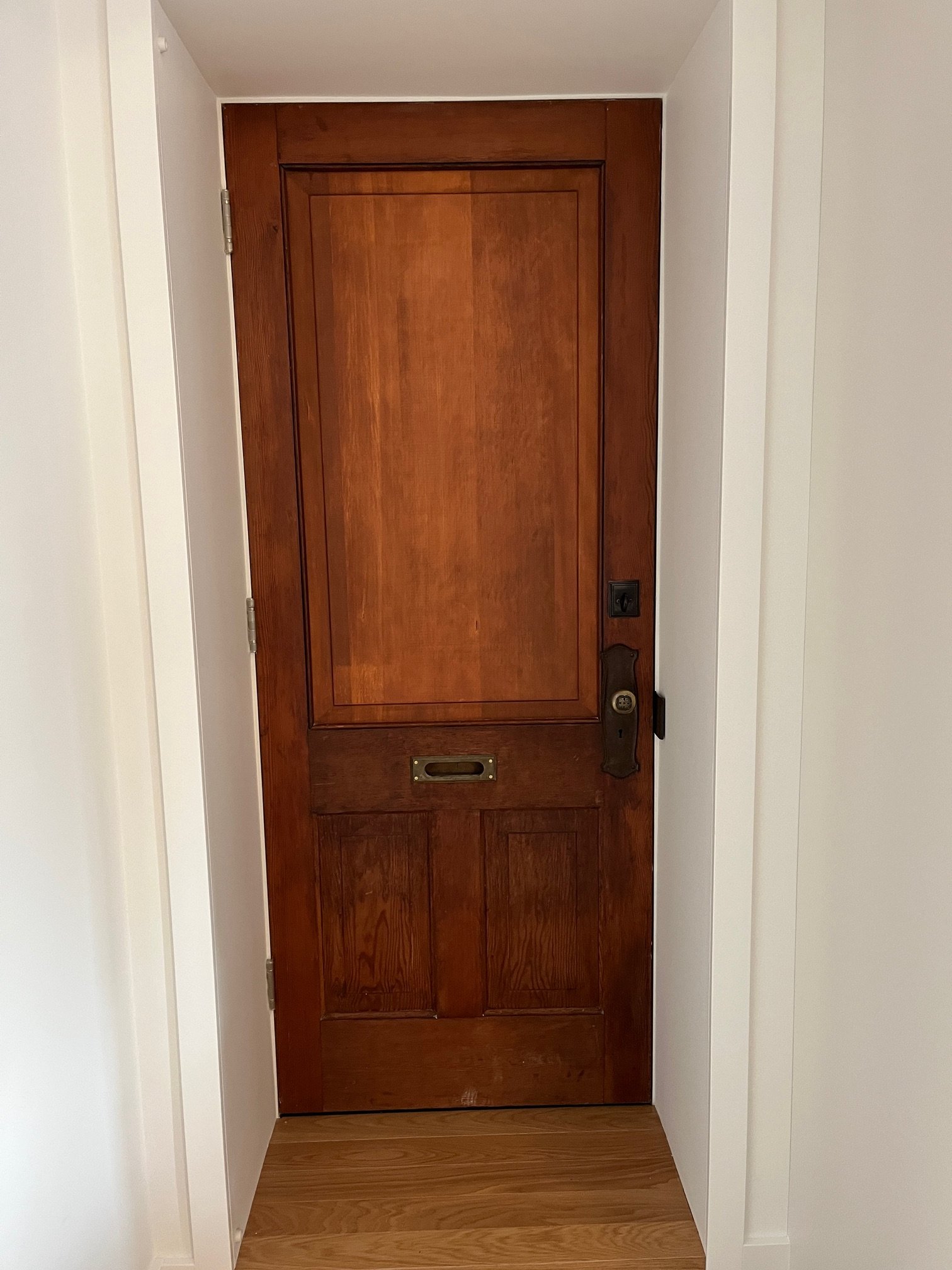
Door from the Allen Residence, formerly located at 204 East 1st Street. Photo by Jennifer Clay.
And in the rental, they repurposed Betty Fleming’s wooden butcher block kitchen countertops as a surface in the laundry room.
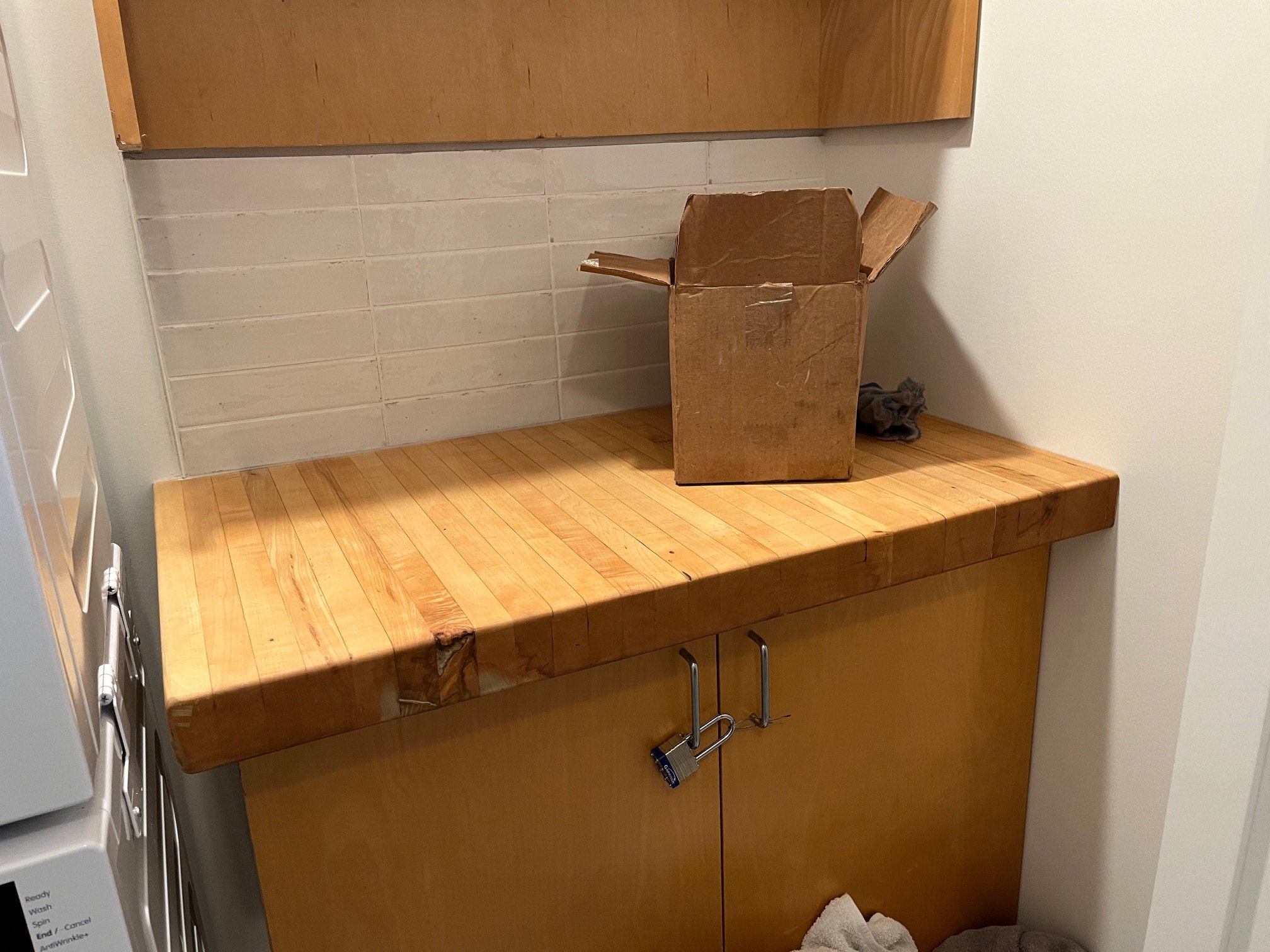
Repurposed wooden butcher block kitchen countertops. Photo by Jennifer Clay.
And voila, after 3 years of planning and 13 months of construction, here she is in all her restored glory! That brings us to the end of this amazing Restoration Story! But please read on for a little more history on the house and the Clegg family.
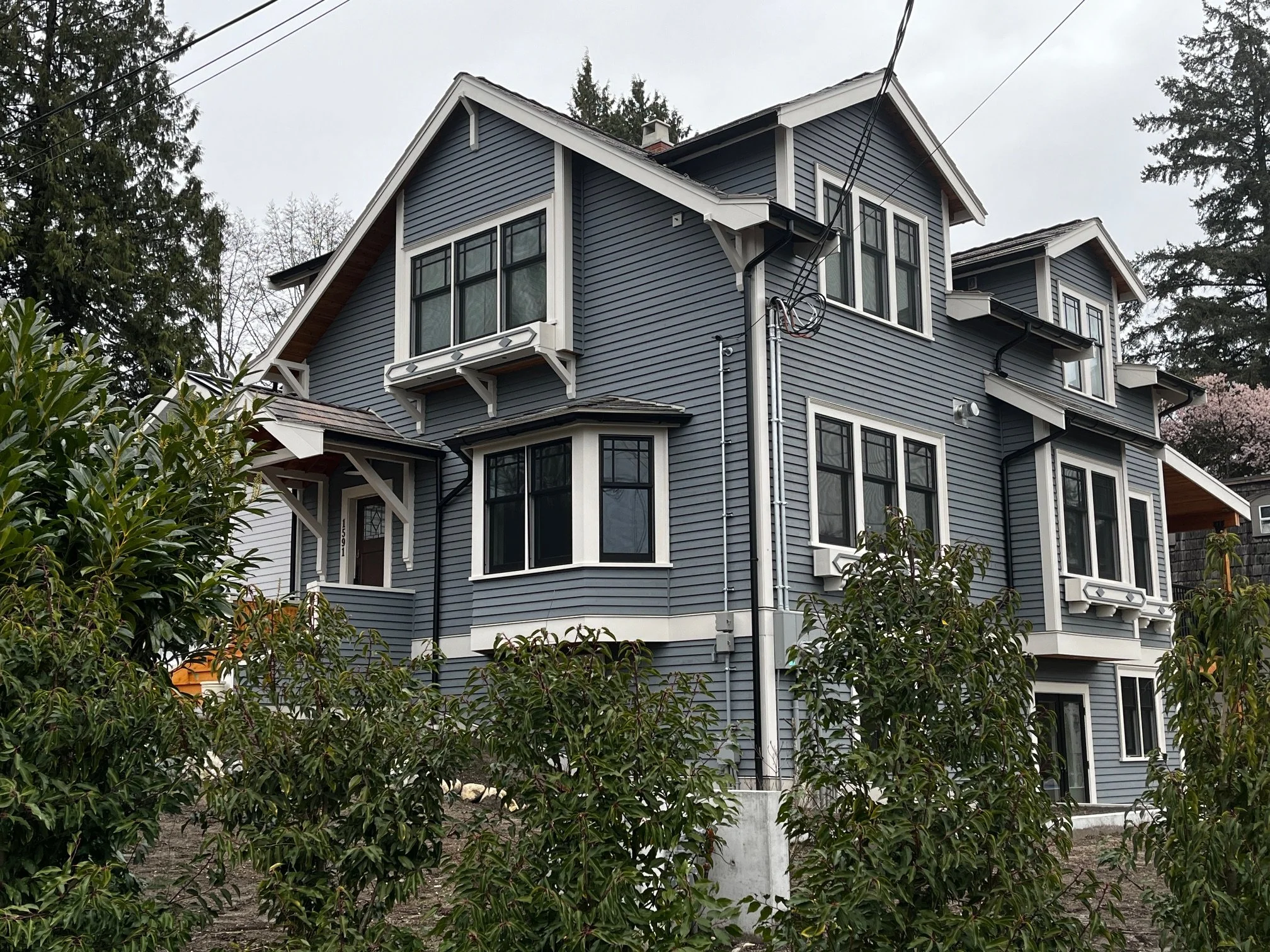
Clegg House. March 2026. Photo by Jennifer Clay.
History of the Clegg House
As mentioned above, the Clegg House was built by Warren and Margaret Clegg in 1929 on District Lot 1055 Block 2 Lot 14. The subdivision of this District Lot had taken place in 1912, at the time that the District of West Vancouver was incorporated, but due to WWI, the lot remained vacant until the following decade, when the economy picked up.
In 1929, Warren Leach Clegg, purchased not only lot 14, the future home of the Clegg House, but also lot 13 for a cost of $575 and $315 respectively. Lot 14 became 1591 Haywood while lot 13 became 1573 Haywood.
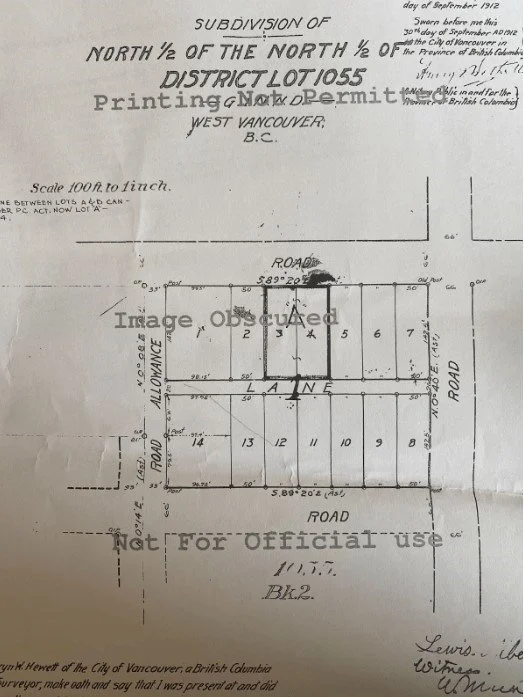
Original 1912 Subdivision Plan: the Clegg House is Number 14 on the corner of the two yet unnamed roads.
The Clegg Family Origins
Warren Leach Clegg was born in Heywood, Lancashire, England on October 11, 1871 to Samuel and Elizabeth (nee Broadbent) Clegg. He emigrated to Canada in 1904 originally settling in the Kootenays before relocating to Saskatchewan, lured by the prospect of farming the Canadian prairies. According to news articles of the time, he was quite successful, growing grain which won prizes at contests in faraway Chicago.
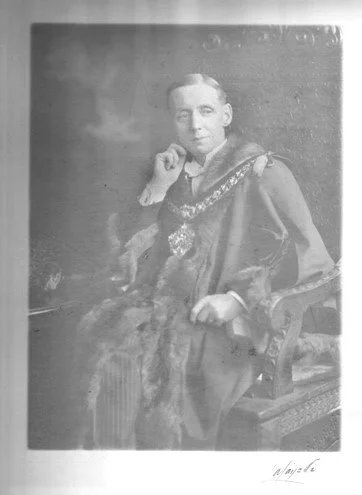
Warren Leach Clegg in his Freemason Regalia. Date Unknown.
Courtesy of the Clegg family via Darrin DeCosta.
Warren Clegg owned his farm in Saskatchewan with two business partners including James Mitchell and Edwin Martindale. Warren would end up marrying James’ sister, Margaret Mitchell, who had also been born in England (January 18,1881, Mossley, Lancashire). They married in 1914 and their first child, John, was born December 6 of that year. Margaret was 33 years at the time of their marriage so there was no time to waste in having children. By 1926, they had four children, John (11), Anne (6), Helena (5), and Edwin (5). In either 1928 or 1929, the Clegg family moved to West Vancouver initially living on the south side of 13th, near Inglewood, according to the 1929 City Directory.
Anne, Ted and Helena attended Hollyburn school beginning in 1929, while John, five years older than Ann, attended West Van High. All four were good students and received mentions in the West Van News and are featured in numerous class photos.
As mentioned at the outset of this article, on February 25, 1929, Warren received a power to act to clear a path to lot 14 and applied for a building permit. Five months later, on July 12, 1929, the family moved in.
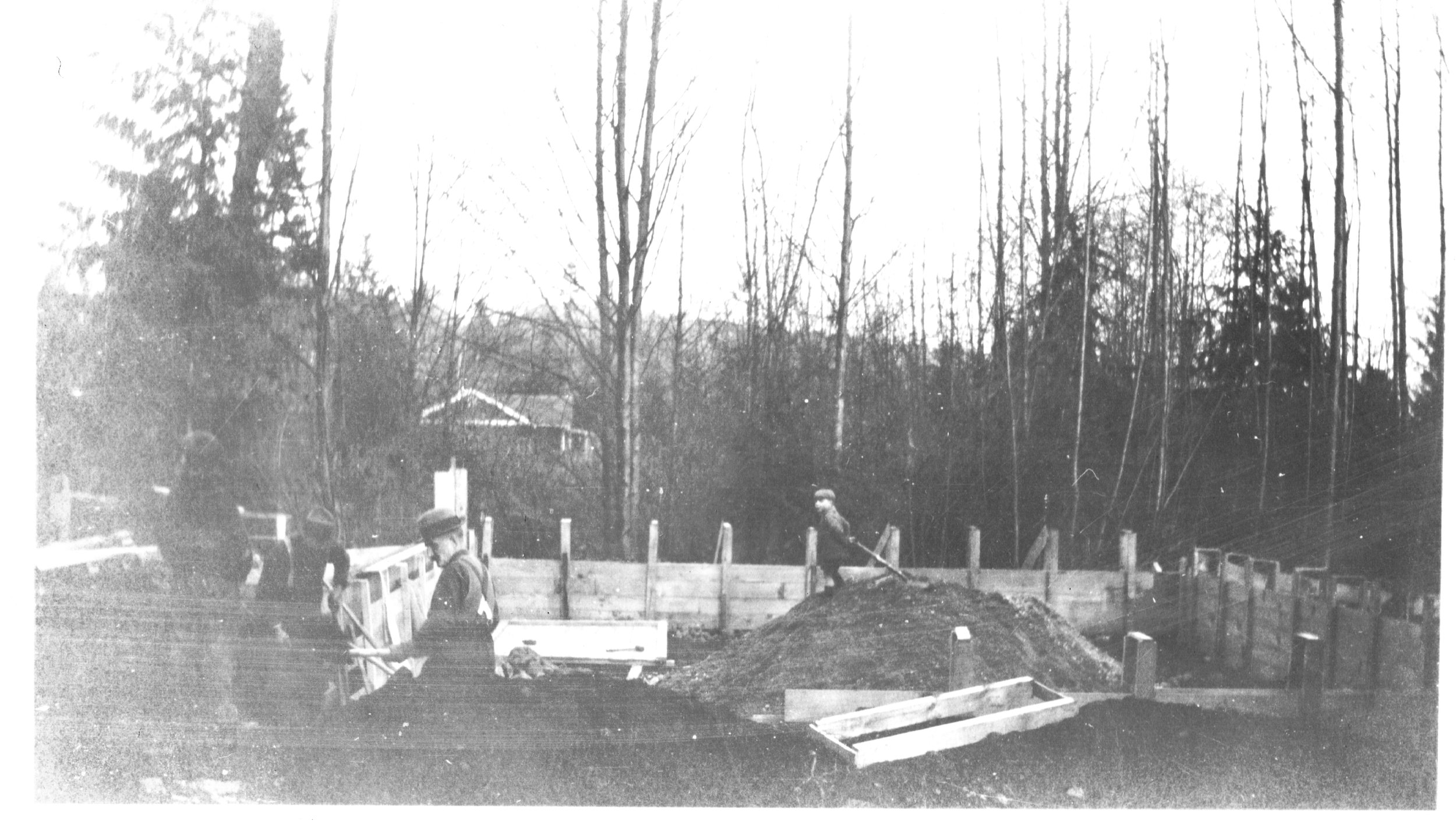
Clegg House Construction, 1929, Courtesy of the Clegg family via Darrin DeCosta.
As already noted, the construction of the Clegg House was completed in July 1929, just a few months before the stock market crash and the ensuing depression. It is therefore not surprising to see that even in 1933, the date of the Fire Insurance Map below, the block was still relatively unoccupied.
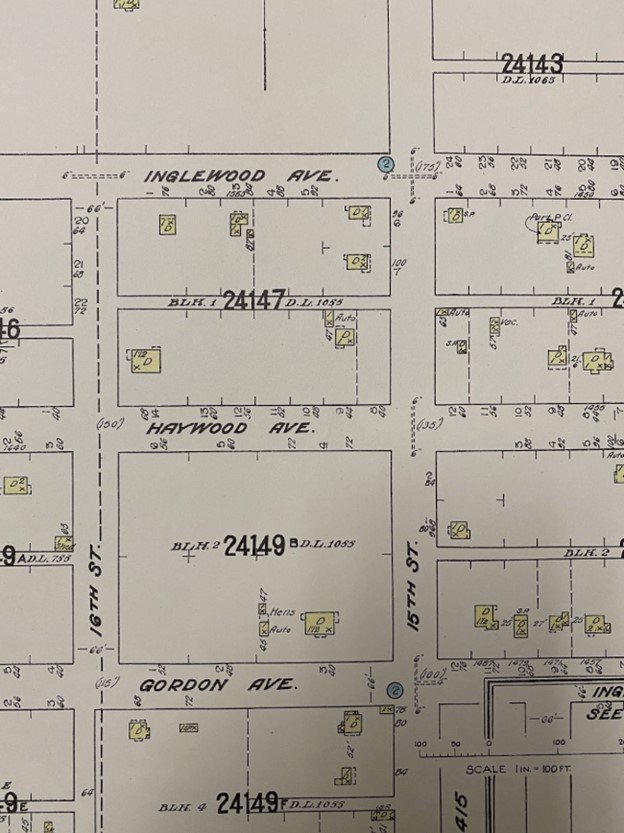
1933 Fire Insurance Map showing the Clegg House on the corner of 16th and Haywood.
The Clegg family was active in the St. Stephens Anglican Church, with the children participating in Christmas pageants and events. Warren worked for many years in West Vancouver as an insurance salesman for Wawanesa Insurance, with offices at 1427 Marine Drive. It is therefore not surprising that the Clegg House was one of the first insured residences in the neighborhood.
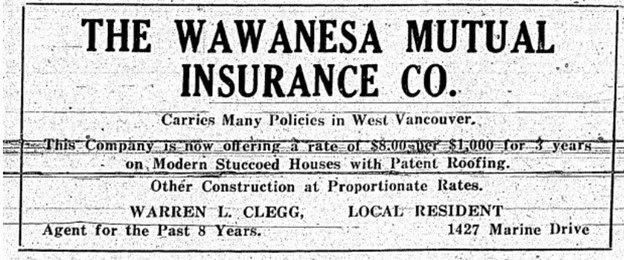
Directory Listing for Wawanesa Mutual Insurance showing Warren Clegg as an agent
In 1936, the family purchased a farm in the Fraser Valley and John, Ted, their mother and their aunts moved to the farm on a permanent basis. Warren, along with his daughters, remained behind in West Vancouver continuing to support the family through his work in the insurance industry.
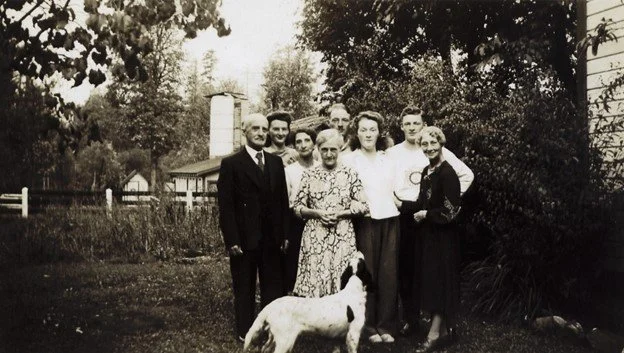
Clegg Family at Abbotsford farm. Date Unknown. Courtesy of the Clegg family via Darrin DeCosta.
In 1938, Warren decided that the Clegg House was too big for his needs, and he sold it to the Forsyth family, downsizing first to 1371 Clyde (1938-1940) and then in 1941, to 1640 Fulton Ave where he lived with his daughters until his death in 1945 at the age of 74. His wife Margaret died in 1984 at the age of 103. Both Margaret and Warren are buried in Capilano View cemetery in West Vancouver.
Thank you to the DeCosta family for saving this house and bringing it into the 21st century in such a respectful way!
Thank you to Darrin DeCosta for so patiently providing me with the technical details of this project!
Thank you to the Clegg family for building this house and providing so many historical details on your family to the DeCosta’s!
Except where indicated, text and images Copyright @ North Shore Heritage and Jennifer Clay. All rights reserved. Republication in whole or in part is prohibited without the written consent of the copyright holder.