
Today, if we need milk, we pop down to the nearest supermarket or corner store and grab some off the shelf. Maybe we’ll check the sell-by date on the plastic container, but there’s no thought as to whether it’s pasteurised or not. That is taken for granted.
It wasn’t always like this. In days gone by, North Shore farmers supplied unpasteurised milk, cream and butter in wooden barrels or metal cans. Usually, by horse and cart. And only to their neighbours. It was impractical to transport fresh products much beyond the vicinity of the farm.
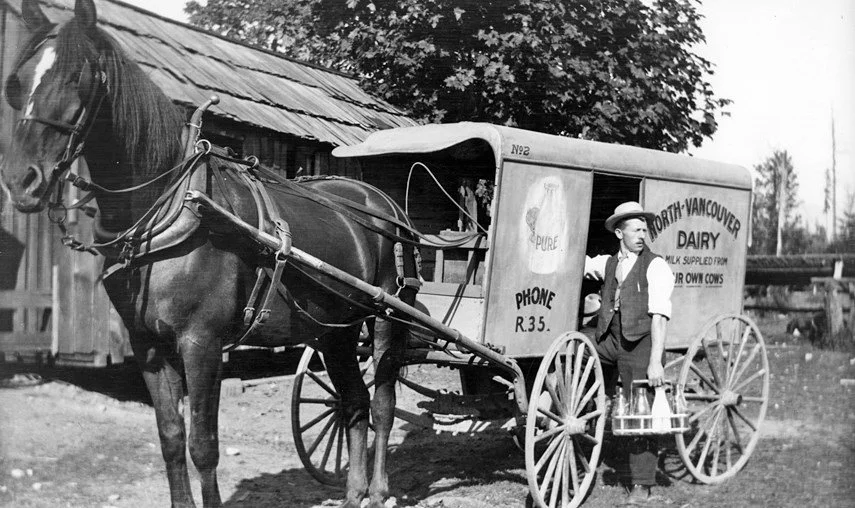
William H Wilkins, owner of North Vancouver Dairy in 1913. Photograph courtesy of MONOVA Archives, inventory number 1980. William and his wife Olive ran a 7- acre dairy farm on Marine Drive, later living at 1560 Macgowan Avenue, North Vancouver, the Wilkins Residence, a 1917 Craftsman that still stands. Anne Marie Lawrence writes about Wilkins in her North Shore Heritage blog article ‘North Shore Farm to Table Tradition’.
The emergence of milk cooperatives around the turn of the 20th century allowed producers to share the expenses and labour of producing milk. Farmers supplied the cooperatives who arranged distribution via dairy supply companies. The returns gave farmers the financial security they needed to upgrade their herds and expand their operation. From 1917, many dairy suppliers across the lower mainland obtained their milk from the Fraser Valley Milk Producer’s Association (FVMPA), one of the largest milk cooperatives in British Columbia.
It was the era of the door-to-door milkman. Usually, the horse would learn its route, plodding along and stopping automatically at houses whilst the milkman rushed from door to door with his metal containers filled with bottles. Managing a delivery route was not straightforward, however, as Frank Bradley, who worked on the North Shore, describes in a memory entitled ‘On the milk route’ quoted in Jane Watt’s excellent book on the British Columbia dairy industry, Milk Stories.
On a horse and wagon route, you arrived at the barn about half an hour before your scheduled loading time, which might be two or three o'clock in the morning. The horse would be harnessed and ready for you, except for the bridle, and you hitched him up to the wagon, lit your kerosene lamp for the tail light, then off to the loading dock. On leaving the dairy you were on your own. Whether you hustled around and finished the route in seven hours or took it easy and made it in nine hours, it was up to you. But you were expected to serve all the customers in a satisfactory manner so that there were no complaints. You had to keep in mind that some of your customers would expect you to be there before their breakfast time and all the customers liked to have a delivery time that they could rely on, particularly during the warm weather. They did not want the milk left out on the doorstep too long before being placed in the ice box. Each month you were required to write up a route book listing names, addresses, and methods of serving all your customers and this would be the book that you would mark the transactions for that customer, what products they bought, whether they paid or charged, and the number of bottles short or over - there was a five cents deposit charge for bottles. Your books had to balance when you turned the route over to a relief man on your days off, so any losses were your responsibility. For customers who were charging their purchases, it was your responsibility to write up bills and make collections. This was a very important part of the job and often it was time-consuming too because you often had to call back on some customers who would not want to leave the money on the doorstep overnight.
In the 1920s and 1930s, motorised vehicles began to replace the horses, but only gradually. Thomas (Tom) Harbottle, who had migrated from England in 1910, established in 1932 a milk delivery business in North Vancouver called Harbottle’s Jersey Products. His son, Jeff, worked with him for eight years until 1940.
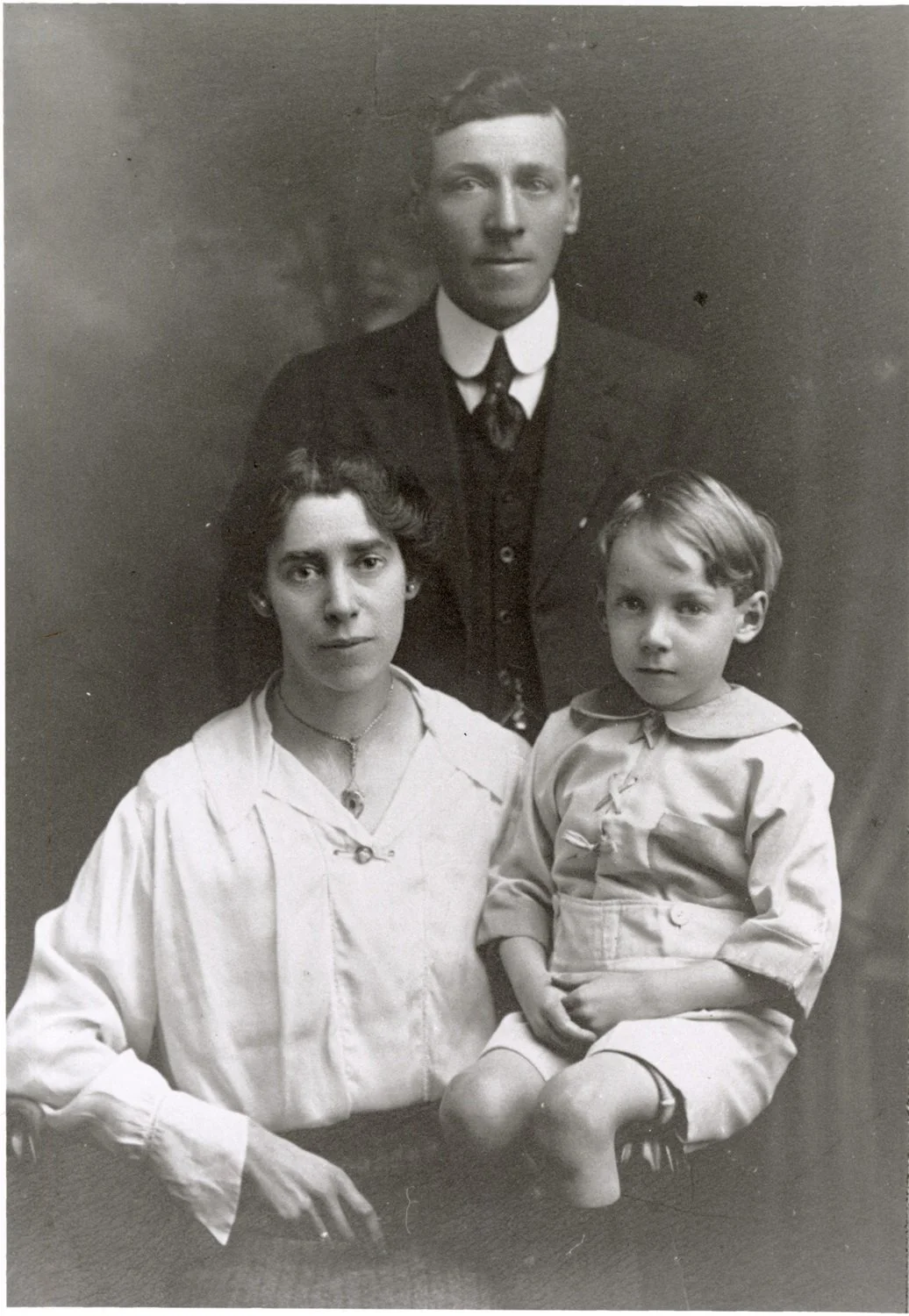
Thomas & Jayne Harbottle and son Jeffery ca 1918. Photograph courtesy of MONOVA Archives, inventory number 7735.
Harbottle Jersey Products was a jobber (distributor) of Jersey Farms, a Vancouver-based dairy supply company that had started up one year previously. Jersey Farms arranged for milk to be transported by ferry across the Burrard Inlet each day for Tom and Jeff Harbottle to deliver to their customers in North Vancouver.
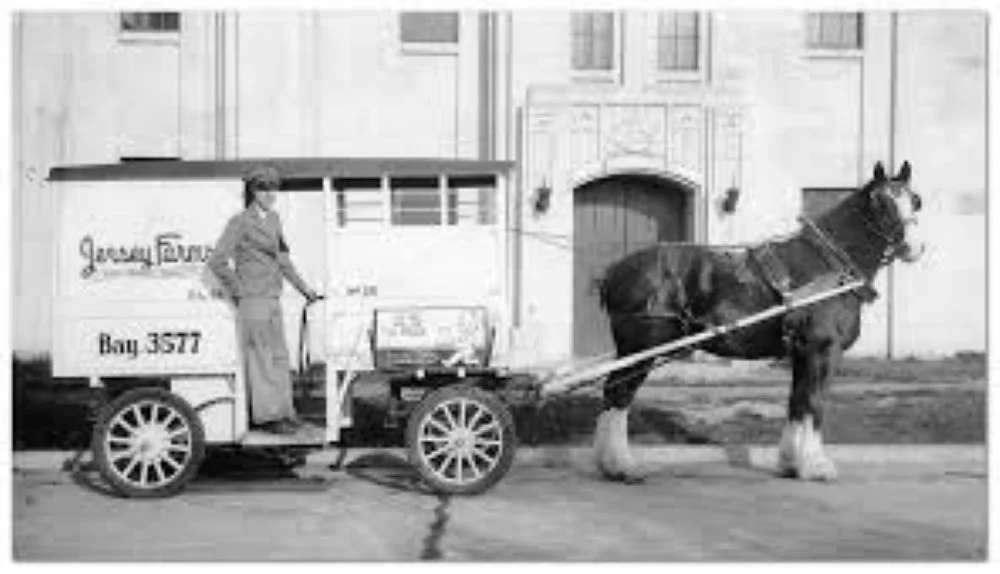
Picture of Jersey Farms wagon, 1948. Common domain photograph. Jersey Farms Limited began its operations in December 1931 with three milk wagons and seven employees. It was the depth of the depression and not the ideal time to start a business. One of the reasons that Jersey succeeded was its use of rubber tire wagons (over the more usual iron wheeled delivery wagons). Though this meant more flat tires than their competitors like Fraser Valley, Jersey offered a quieter delivery.
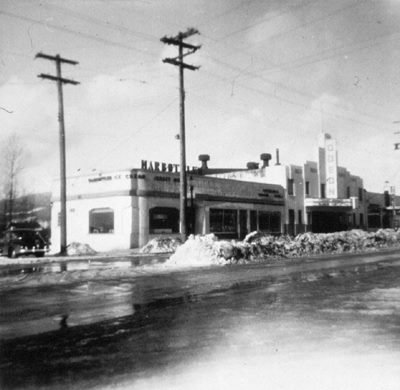
1401 Lonsdale Avenue, North Vancouver showing Harbottle’s Jersey Products store and the Odeon Theatre ca 1950. Photograph courtesy of MONOVA Archives, inventory number 8791. Neither building has survived.
Tom Harbottle started his business with a 1931 Chevrolet truck. He also owned a 1925 Chrysler. As Jeff, his son, recalled in 1993, speaking about those times:
If a truck broke down, we would take the back seat out of the Chrysler and deliver with it, especially up North Lonsdale if there was heavy snow. The car with chains could go through snow right up to its bumper.
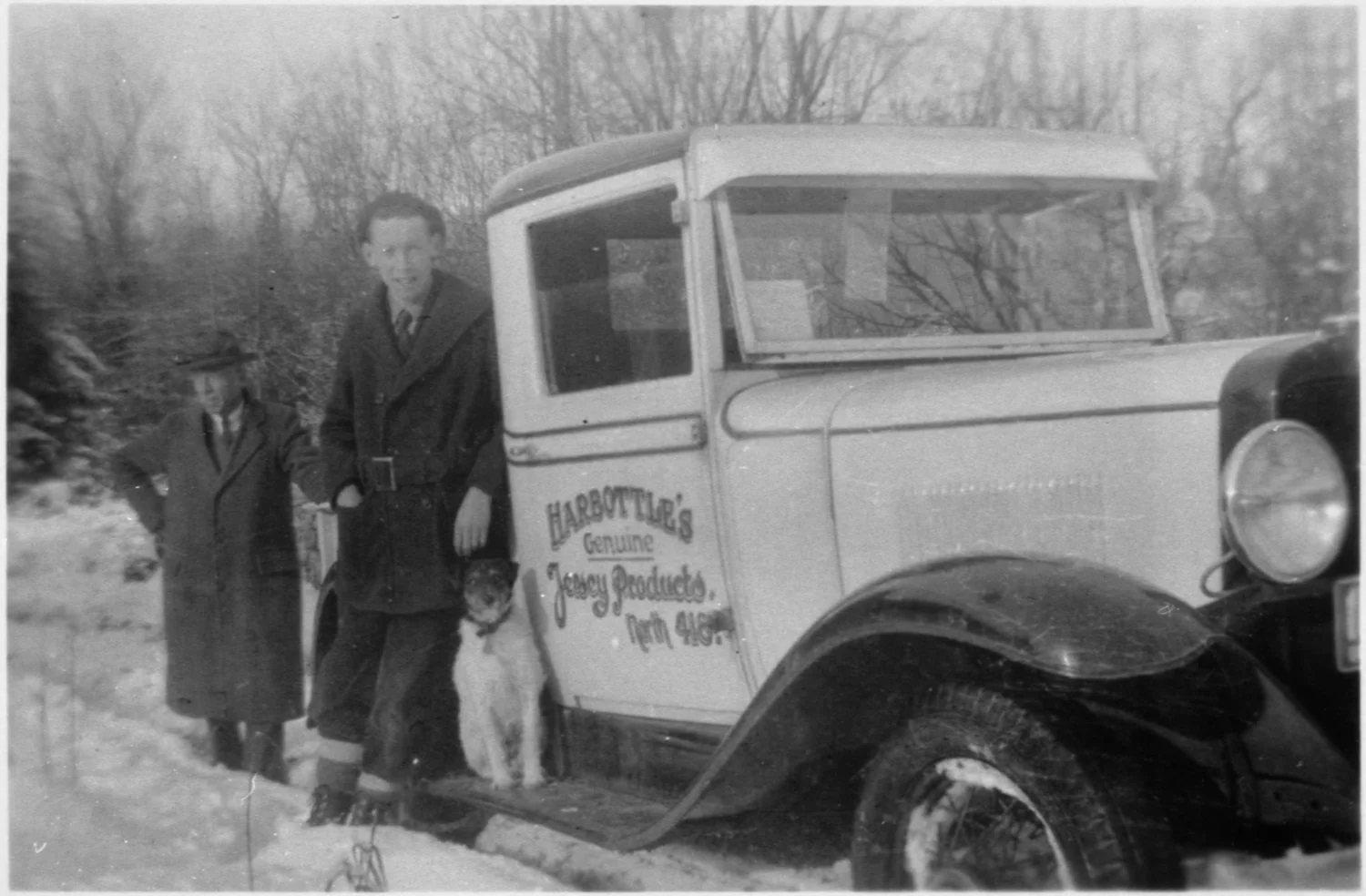
Harbottle’s 1931 Chevrolet truck ca 1932. Photograph courtesy of MONOVA Archives, inventory number 8793.
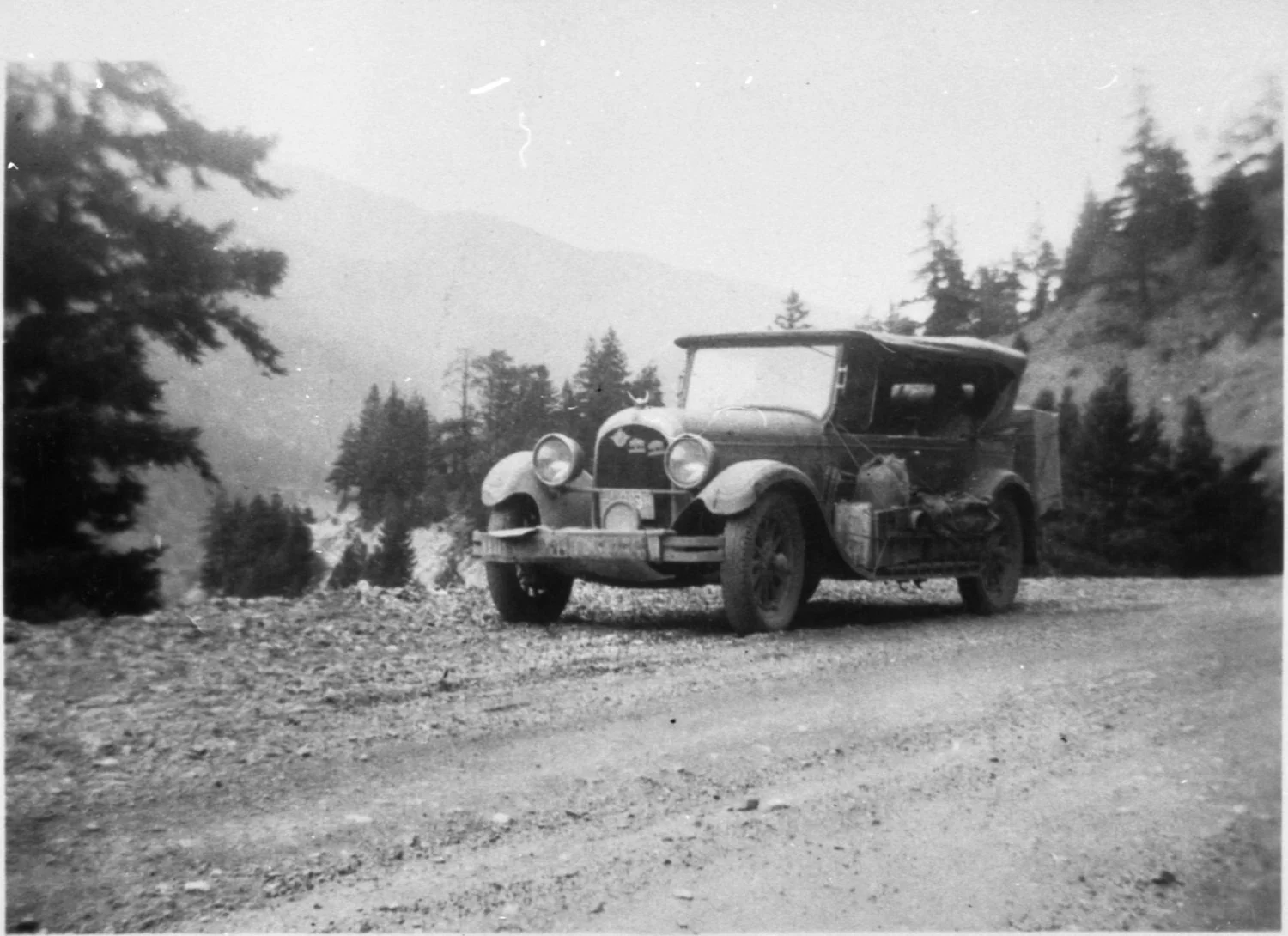
Harbottle’s 1925 Chrysler in the 1920s. Photograph courtesy of MONOVA Archives, inventory number 8794.
In 1938, Harbottle’s Jersey Products purchased a new Diamond T truck as a delivery vehicle. Jeff Harbottle personally travelled to Chicago to pick up the truck and drive it back to North Vancouver. When the Harbottles sold their business to Jersey Farms in 1942, the company’s Diamond T truck was included in the sale. Over time, the truck rusted up, ending up on a scrap heap where, in 1971, vintage car collector Dennis Montgomery found it. Montgomery cleaned up the vehicle and in October 1986 displayed it with other antique vehicles at Vancouver’s transport and communication fair, Expo 86, where it came to Jeff Harbottle’s attention. Dennis had discovered a set of Harbottle dairy milk bottle caps under the truck’s seats, confirming that it was the same truck Jeff had driven back from Chicago decades earlier. In 1991, Jeff acquired the truck from Montgomery, initiating a project to restore the truck to its 1938 state. This was completed in 1999. In 2003, Jeff donated the truck to MONOVA who held it until 2025 before donating it to the BC Vintage Truck Museum in Surrey where it resides today as a memory of older times.
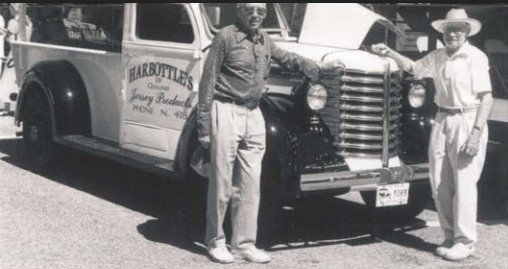
Jeff Harbottle (left) and Frank Bradley (right) with the restored 1938 Diamond T truck in 2000. Photograph courtesy of Neil Gray Collection.
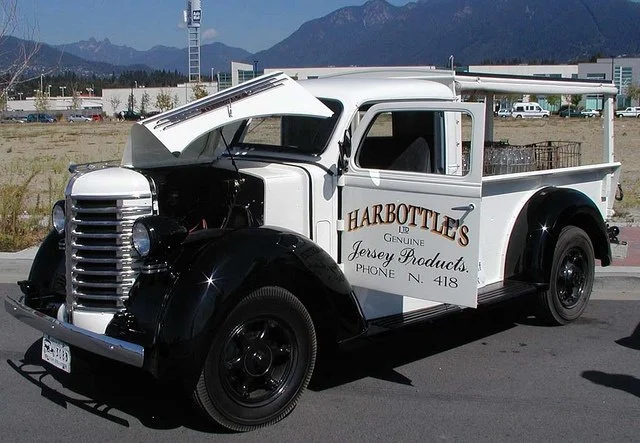
Harbottle’s Jersey Products’ restored 1938 Diamond T truck. Photograph courtesy of the BC Vintage Truck Museum.
Except where indicated, text and images Copyright @ North Shore Heritage and Paul Haston. All rights reserved. Republication in whole or in part is prohibited without the written consent of the copyright holder.
References:
MONOVA, North Vancouver Museum and Archives https://monova.ca/archives/
British Columbia City Directories https://bccd.vpl.ca/
‘Milk Stories, a History of the Dairy Industry in British Columbia, 1827-2000’ by Jane Watt.