
In December 1894, 20-year-old Italian engineer Guglielmo Marconi demonstrated a radio transmitter and receiver to his mother. Pushing a telegraphic button on a bench, he made a bell ring on the other side of the room. Wireless telegraphy, the transmission of messages by radio waves, had been invented. By the time the SS Titanic hit an iceberg and sank off Newfoundland in April 1912, messages using Morse code crossed the Atlantic. The age of radio had arrived.
One exponent of the new technology was Walter Lambert. Born in 1893, Lambert gained his early knowledge during World War I, serving four years as a wireless operator with the Royal Canadian Navy, before joining the SS Robert Dollar, a cargo ship, as chief wireless operator.
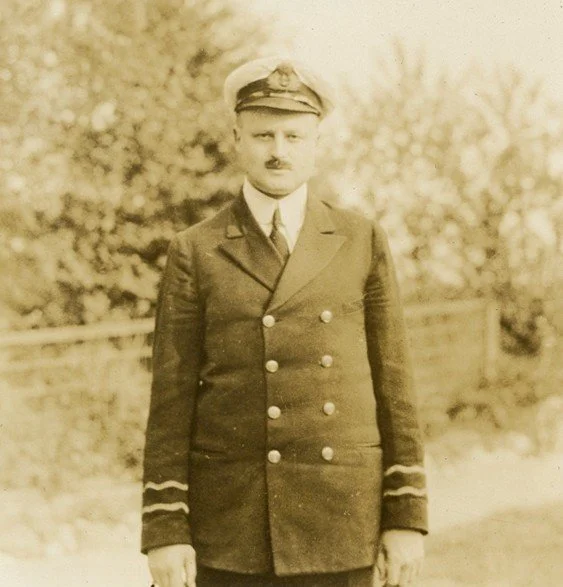
Lambert in uniform. Photograph courtesy of W J Bowerman collection.
Lambert began teaching radio classes in 1920, continuing to serve as a radio operator during his summer vacations. Students at a two-year radio telegraphy course at the Sprott Shaw Business Institute in Vancouver included Donald Hings, Canada’s inventor of the walkie-talkie. Demand for radio operators was increasing and Sprott Shaw dominated the market for training. Up until the early 1920s, courses focused on damped “spark gap” telegraphy used for marine and naval communication. By 1925, instruction shifted toward vacuum tube continuous wave technology, amplification modulation and early telephony driven by the growth of commercial radio stations.
Lambert was strict, but held in the highest regard by his students. A man of Christian principle, he presented each student upon graduation with a copy of the New Testament, his favourite text from the Book of Romans underlined.
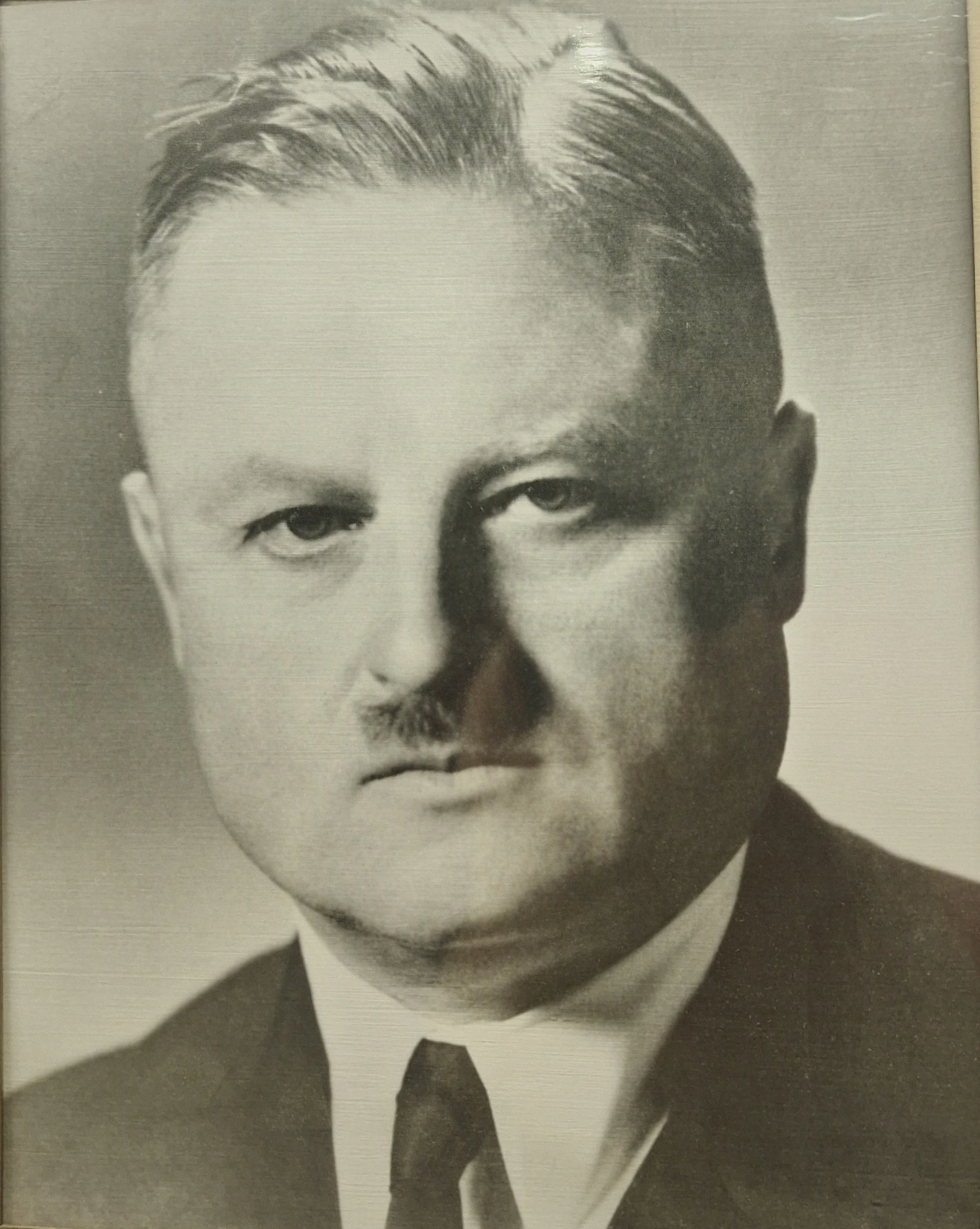
Walter Lambert (1893-1957). Common domain photograph.
A rival to Sprott Shaw was the public school system. In 1926, Lambert was recruited as head instructor of the radio programme at the King Edward High School. The course became known as ‘Room 19’, named from the classroom where it was taught.
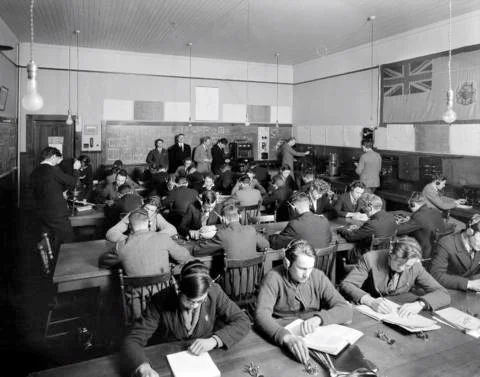
Room 19 students with Walter Lambert standing tall at the front of the class in 1930. Photograph courtesy of the City of Vancouver Archives.
Shortly after his Room 19 appointment, Lambert moved from his residence in Vancouver to a house at 872 Cumberland Crescent, North Vancouver. Built by McAlpine Robertson Construction Company in 1911, the Craftsman-styled house, one of six equally spaced in the development, became his residence for the next 20 years.
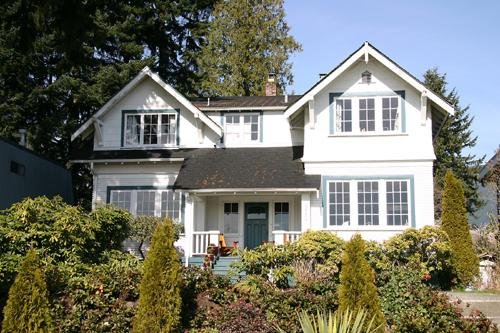
872 Cumberland Crescent. Photograph courtesy of MONOVA Archives.
Lambert’s love of the sea extended beyond his time spent working on ships. A keen canoeist, he gained fame crossing the Straits of Georgia and Juan de Fuca more than 30 times in his 16-foot canoes, Tenebris I and Tenebris II, usually at night. Later in life, he completed a 300-mile canoe paddle up the west coast of Vancouver Island, known for its stormy weather.
Donald Hings kept in touch with his early mentor and, after World War II, expressed his gratitude by helping Lambert establish a marine radar training programme at Room 19, the first on record in Canada.
Ill health forced Lambert’s retirement from his position at King Edward High School in 1954. He spent his final days at Milnes Landing near Sooke, before passing in 1957. Thereafter, he continued to be remembered with affection by those he had taught.
If you are interested in the development of early radio please take a look at my recently published biography of Donald Hings, available on Amazon:
https://www.amazon.ca/Donald-Hings-Walkie-Talkie-Paul-Haston/dp/B0HRSVWTKB/
Except where indicated, text and images Copyright @ North Shore Heritage and Paul Haston. All rights reserved. Republication in whole or in part is prohibited without the written consent of the copyright holder.
Other References:
MONOVA, North Vancouver Museum and Archives https://monova.ca/archives/
British Columbia City Directories https://bccd.vpl.ca/