In preparation for our December post, I visited the North Vancouver Archives website and entered the words “snow” and “house” into the keyword field. The search results provided me with a fantastic selection of photos taken from 1911 into the 1930’s. Some of the photos were well-labelled with easily recognizable buildings while others required some serious sleuthing. For each photo, if it was not already known, I used the archival City Directories or permit books to determine the owner of the home at the time the photo was taken. I also visited the location where each photo was taken and was pleasantly surprised to find that at least one building in each photo still exists today. As much as possible, I tried to duplicate the photo with a present-day shot, although with our mild December, I was sadly unable to duplicate the snowy conditions! I hope you enjoy this wintery walk through early North Vancouver, starting with the oldest photo and moving chronologically through them.
First Ridgeway School and 424 E 9th
We all know Ridgeway School as a beautiful brick and sandstone structure that straddles East 8th and 9th on Ridgeway Street. However, most may not know that this building was in fact the second Ridgeway School. The first Ridgeway School, a house-like structure, sat on the north-west section of the current lot, approximately where the tennis courts are today. The original Ridgeway School is pictured in this photo, which was taken around 1911, when the second (current) Ridgeway School was being constructed (1911-1912). While the construction activity of the 2nd school has not been captured in this photo, in the distance, you can see another house. This house is at 424 E 9th Street and is still standing today, more than one hundred years later!
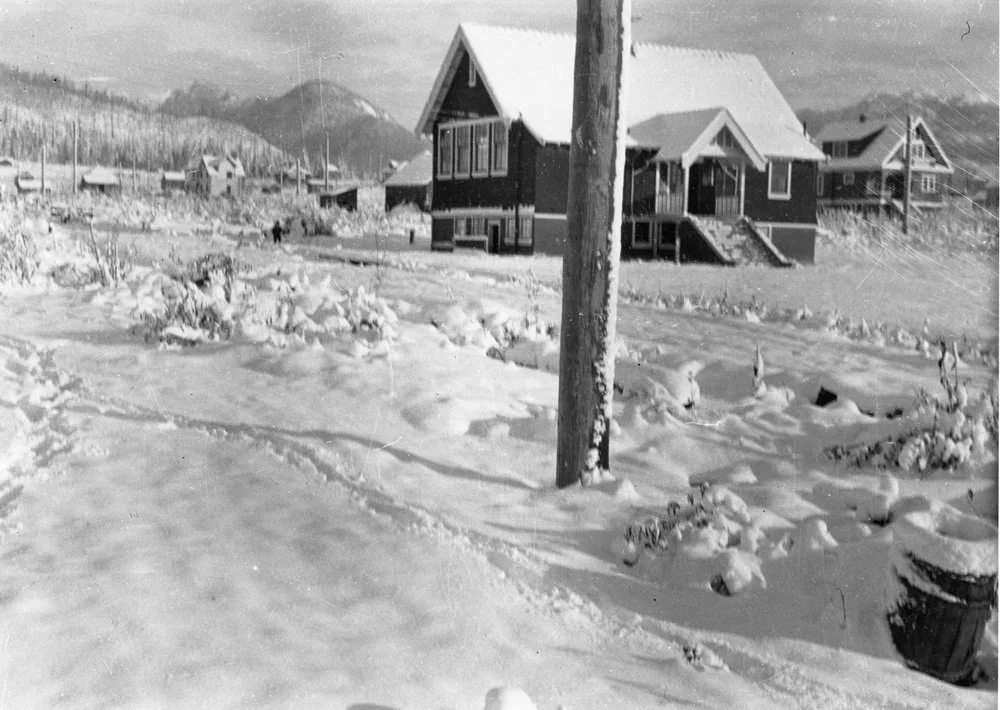
First Ridgeway School with 424 E 9th at right, circa 1911. Inventory 6361. Courtesy of MONOVA/North Vancouver Archives.
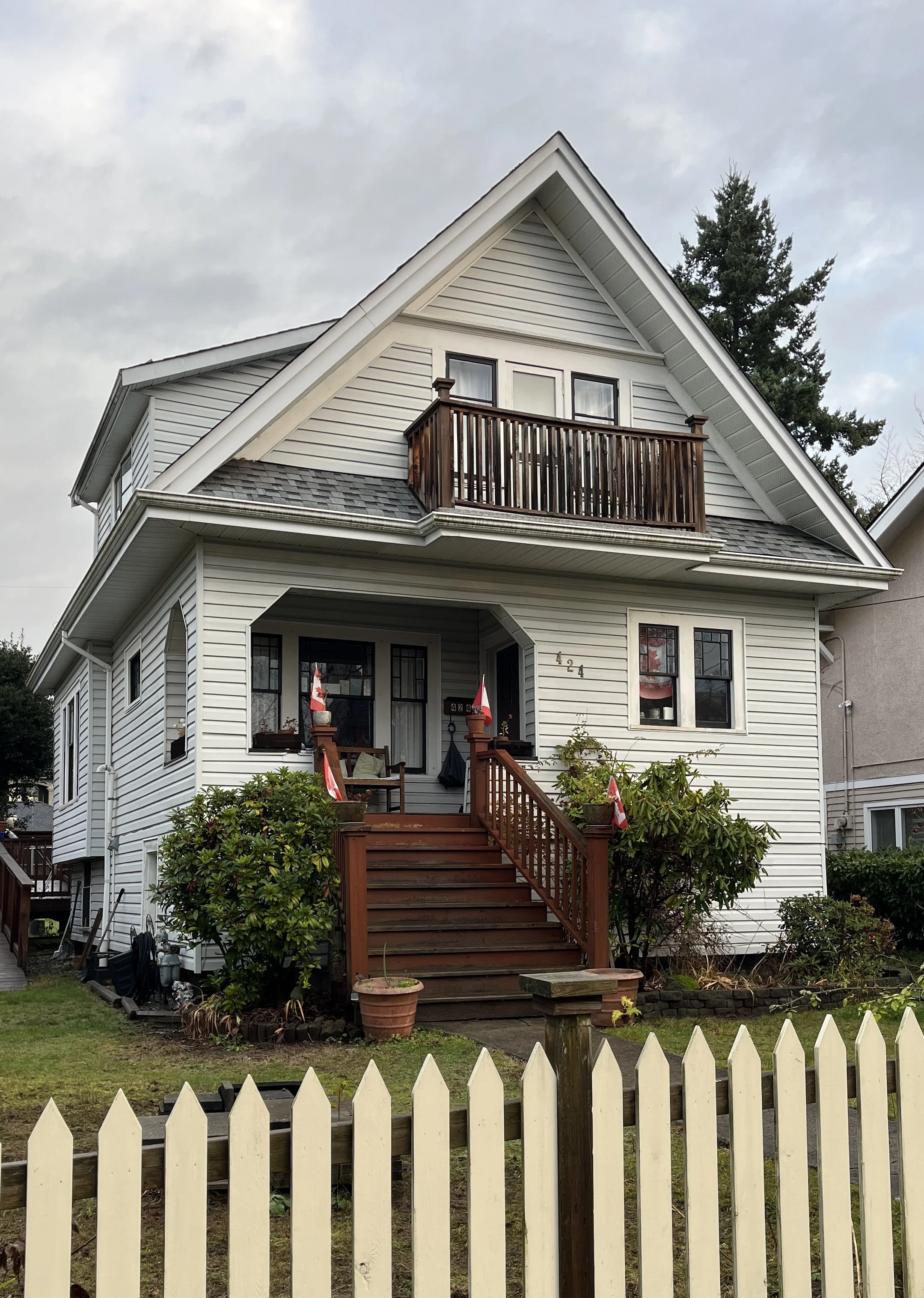
424 E 9th Street, December 2025. Photo by Jennifer Clay
BC Assessment records indicate that 424 E 9th was built in 1911, although according to the archival building permit book for the CNV, a permit for an “addition to house” was taken out in 1911, so the house might be even older. The permit was given to a T. Dennis, and he appears as the owner in the archival city directories from 1911-1914 under Tom Denny, Thomas Denny, T. Dennie, T. Denny (directory information was manually collected and hence, there are lots of spelling variations). Although his profession was not listed from 1911-1914, he is listed in the 1915 directory as a Lumberman, then living at 317 E 9th, which also is still standing! You may wonder what happened to the first Ridgeway School. It appears to have been retained on the northwest corner of the Ridgeway school grounds until at least January 1968, when it seems to have been damaged in a fire as per the details provided for the archival photo #3928 (not featured in this article).
300 or 400 block E 8th (we think!)
Moving along, this next photo was taken one year later in the same general vicinity as the photo above. Based on the description of the donor of the photo, it is identified by the Archives as “300 or 400 block East 8th ?”. The second Ridgeway School (1911/1912) occupies the 300 block of E 8th and was under construction or completed at this time, so either the location or the date of this photo is incorrect. I believe that the date is incorrect. I think it was taken before 1912.
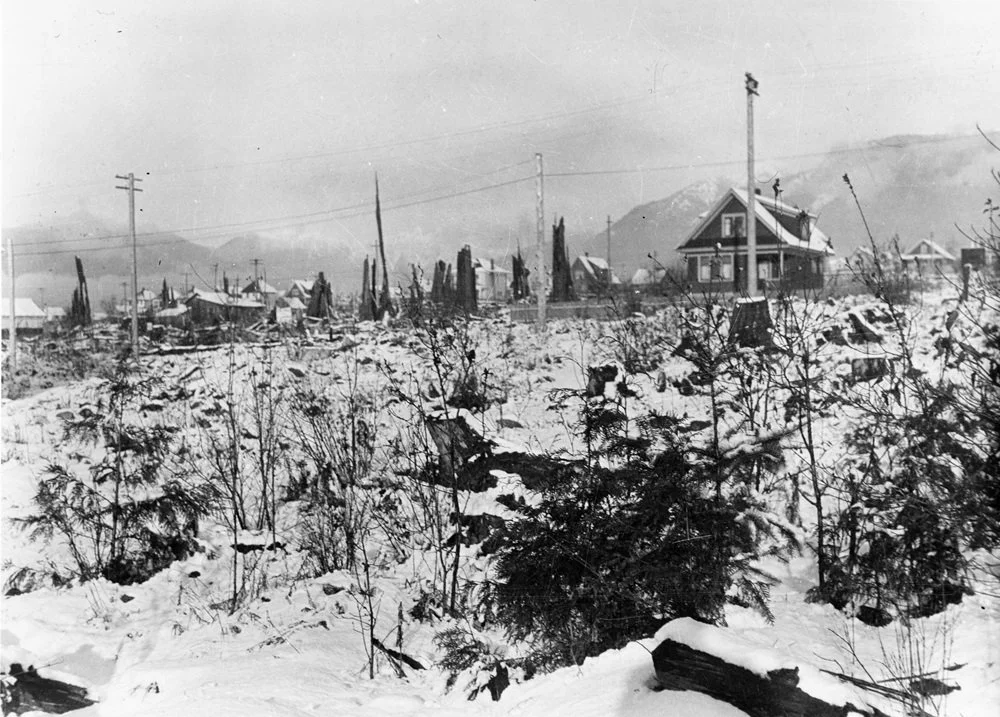
300 or 400 Block E 8th. Inventory #6351 circa 1912. Courtesy of MONOVA/North Vancouver Archives.
In studying the photo, I honed in on the large white building that is two buildings to the left of the large house. I believe that the white building is located at 362 E 10th, on the corner of Ridgeway. If you look at this building today, the chimney is also on east side of the house, but is strangely nestled into the peak of a roof, which would indicate that the upper floor and roof were added at some point.
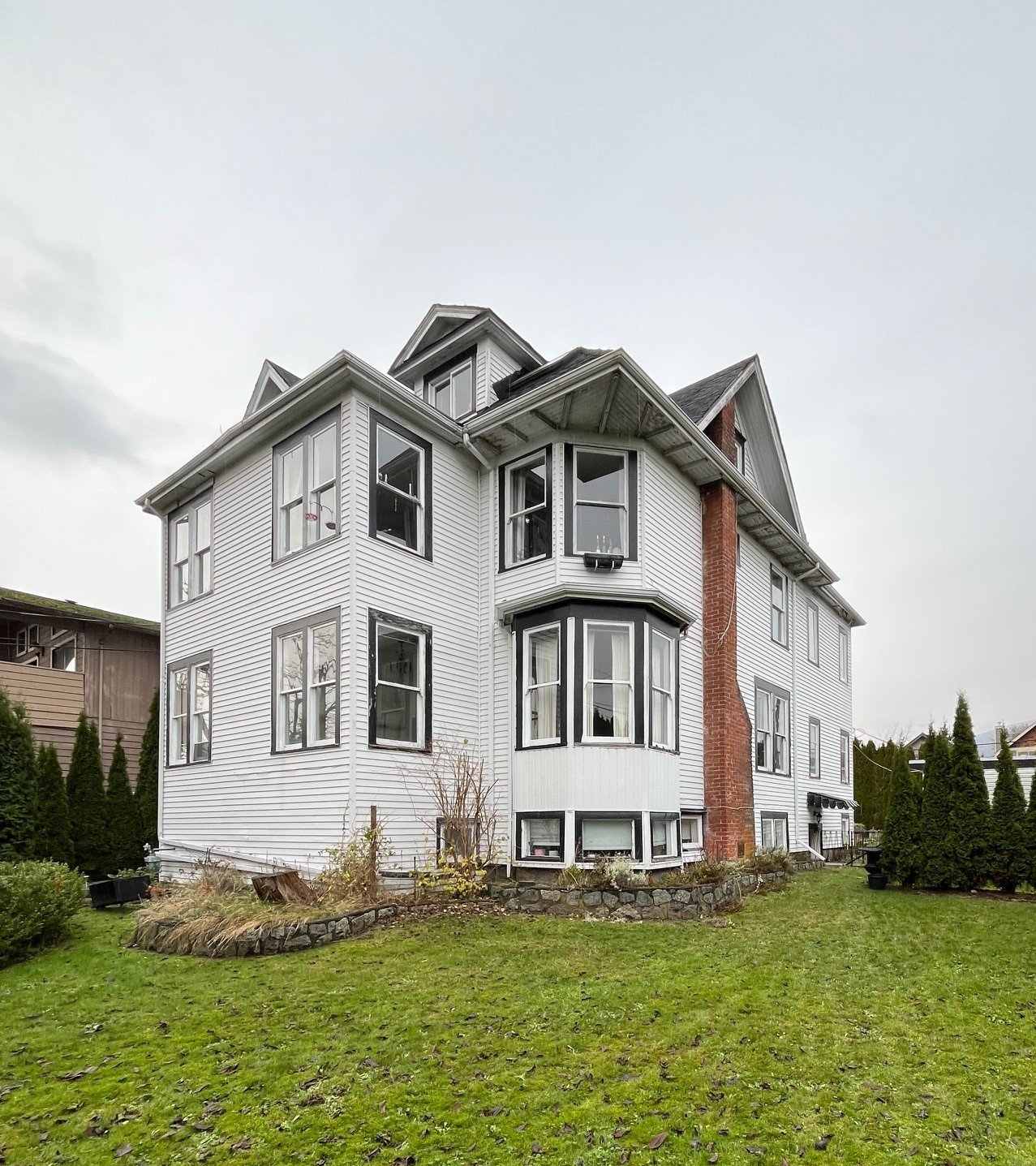
362 E 10th Street, December 2025. Photo by Jennifer Clay
According to BC Assessment, 362 E 10th was built in 1910. So, if in fact, the archival photo was taken in 1910, then this house would have been built, but Ridgeway School would not yet have been built which would explain the large tract of vacant land in the foreground of this photo.
In reviewing the building permits for this address, I could not find any permit for the original construction of 362 E 10th but I found that in 1913, Archie L. Clements took out a permit for a garage, and that in 1937, RJ Steacey got a permit to make alterations to the house (presumably the addition that enclosed the chimney in the peak of the new roof). Then in 1943, Mr. Steacey converted it into 6 apartments which is still the case today. According to the archival city directories, Archie Clements was employed by Evans Coleman & Evans in Vancouver, who are listed in the directory as Shipping, Coal and Commission Merchants, Railway Builders and Cannery Suppliers, and providers of Marine Insurance. Quite the range of services!
So, if we assume that the white building in the archival photo is located at 362 E 10th, and based on the angle, then the prominent house behind the pole would most likely have been in the 400 block of East 8th although if that’s the case, that house must have been demolished as there is no likeness of that house today.
I did find one house at 358 E 9th that looks like this house but that would put it in the same block as the white building at 362 E 10th so this cannot be right. In my opinion, the only house from the archival photo that exists today is the white apartment building.
S. Hansen Speculation Houses - 341 and 345 West 20th
This photo, taken in 1912, depicts two homes standing all alone in the middle of a vast open area. Similar to the photo above, this was the time when North Vancouver was being developed and it was standard to clear cut and then burn the land, before the lots were sold. However, in this case, it looks like the area was already outfitted with electricity, based on the presence of the power pole! I find this truly amazing!
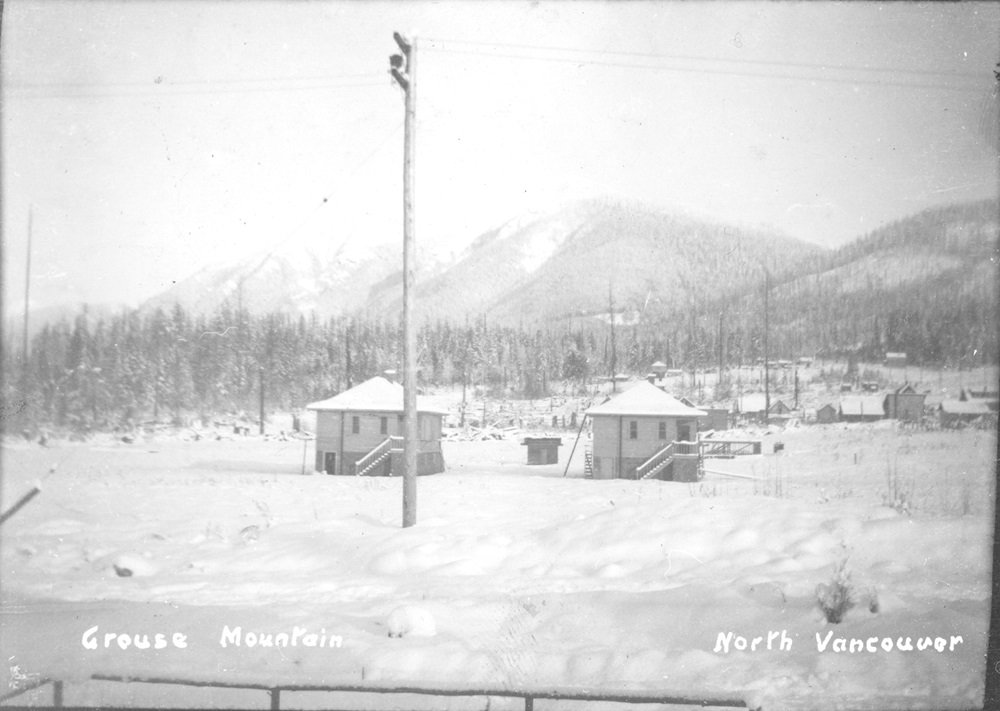
North from 300 block of W 19th. Grouse Mountain in background. Rear view of two houses at 341 (at right) and 345 W. 20th. Inventory 127 (Winter 1912). Courtesy of MONOVA/North Vancouver Archives.
Lucky for me, the addresses of the two homes were provided to the Archives by the donor of the photo. But I wanted to see who the first owner of each home was. The CNV permit records show that an S. Hansen took out a permit in 1912 to build two houses, one each on DL 547 Block 4, Lots 53 and 51 and these check out with the legal description of the homes at 341 and 345 West 20th respectively. I was interested in what profession was listed for Mr. Hansen in the city directories. He was not listed as a resident of North Vancouver, but in reviewing the 1912 Vancouver directory, S. Hanson (another spelling) is listed as a builder, living at 2425 West 8th Street in Vancouver.
So, it seems that these two houses were built as spec houses by Mr. S. Hansen. The archival directories in 1912 do not allow one to search by address so I don’t know who lived there initially but by 1920, Patrick Hanlon, a boilermaker with Wallace Shipyards was living at 345 W 20th, and by 1921, his co-worker from the Wallace Shipyards, Harry Nott, whose employment was listed as “helper”, was living at 341 W 20th.
I did a quick check of the 1930 Fire Insurance Maps for North Vancouver, and found that, almost 10 years after these two homes were built, there were still only 3 homes on that block, including a third home at 319 West 20th (owned by Ernest Rhodes who was a grocer).
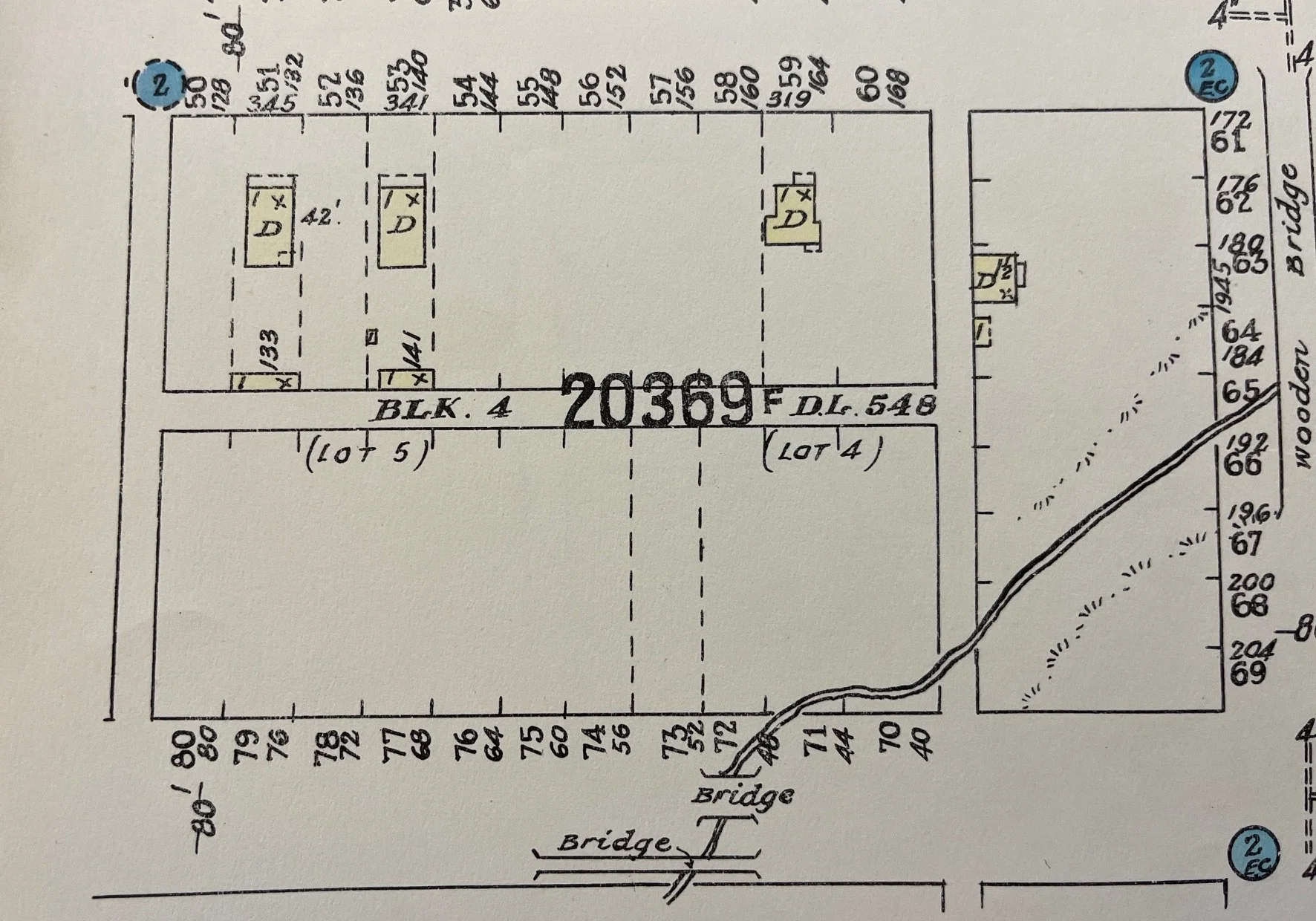
Fire Insurance Map of 300 block of West 20th in January, 1930, showing the buildings located at 345, 341 and 319 West 20th. Courtesy of MONOVA/North Vancouver Archives.
Here are the two homes today at 341 and 345 W 20th, now with another house at 343 W 20th in between. I could not duplicate the exact 1912 photo as it was taken from behind these houses, many blocks to the south, and that whole open tract of land in the archival photo is now full of houses.
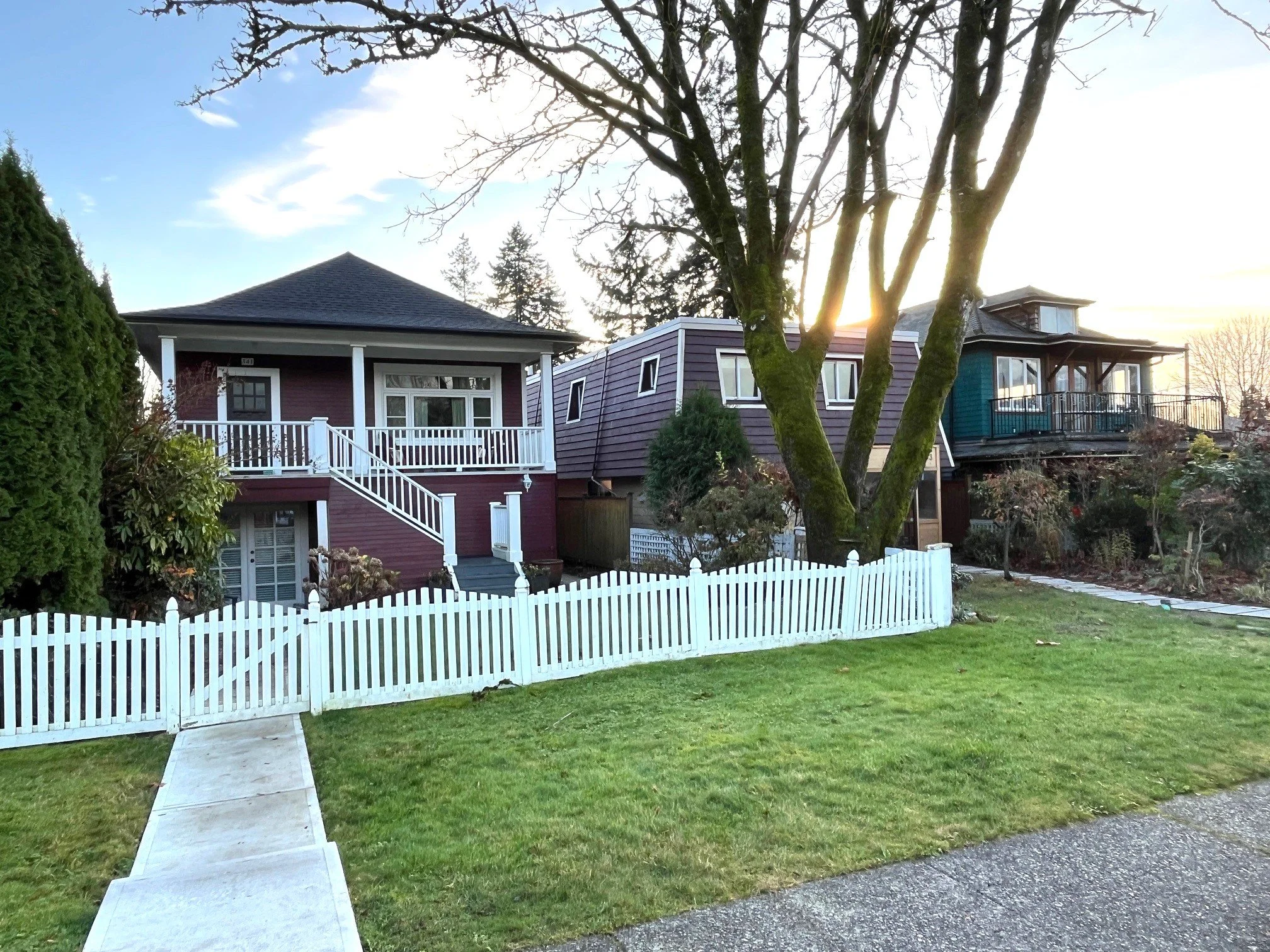
341 and 345 W 20th, December 2025. Photo by Jennifer Clay
Dovercourt Hotel
This next photo should be easily recognizable to most people. It is the Dovercourt Hotel at 1606 Lynn Valley Road, taken in January 1916.
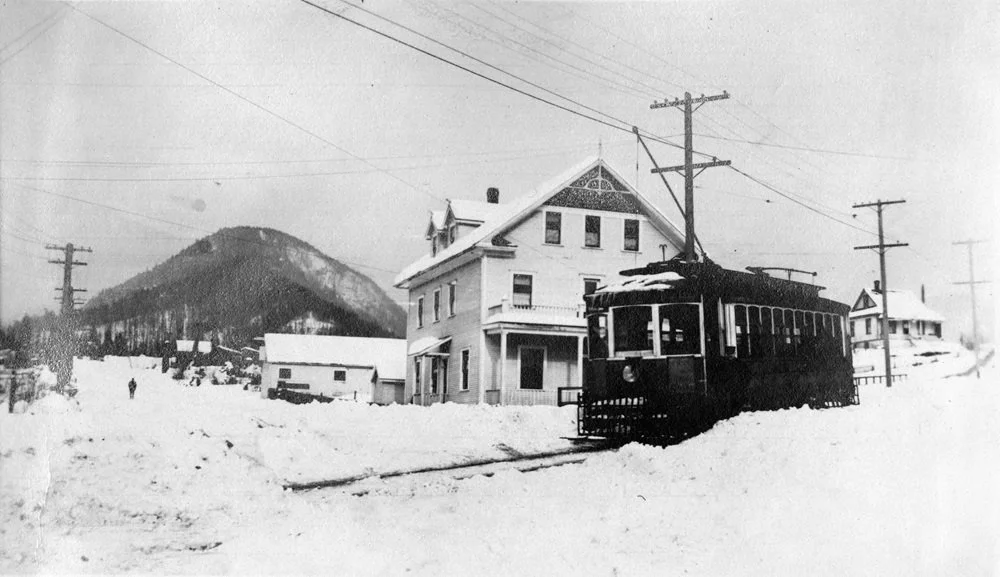
Dovercourt Hotel and Streetcar in Winter, with Lynn Peak visible in the background. Inventory #5446. Date taken Jan 1916. Courtesy of MONOVA/North Vancouver Archives.
While the streetcar is long gone, the Dovercourt Hotel building is still there, on the corner of Lynn Valley Road and Hoskins, in a fresh coat of barn-red paint. It is now a branch of the Lookout Society but is still called the Dovercourt Residence.
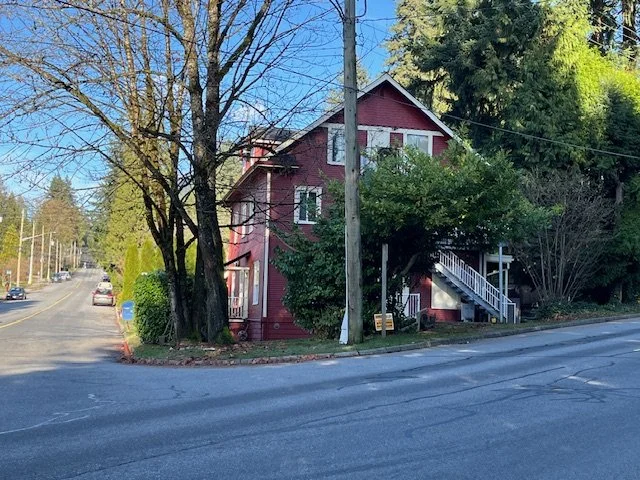
1606 Lynn Valley Road, December 2025. Photo by Jennifer Clay
According to a book called Early Days in Lynn Valley, the hotel was built in 1909 by Harry Holland, an Englishman, only a year after arriving in Canada. Having arrived from a country whose citizens enjoyed a pint or two, it had been his intention to include a beer parlour at the hotel, but his application for a liquor licence was thwarted by the local Presbyterians who determined that “the granting of a licence would have a damaging effect on the morals of young people”. But Harry Holland persisted and operated the hotel as a “dry” hotel.
Tempe House (437 Somerset)
This photo, taken around 1916, showcases the south and west sides of 437 Somerset, after what was clearly a major snowfall.
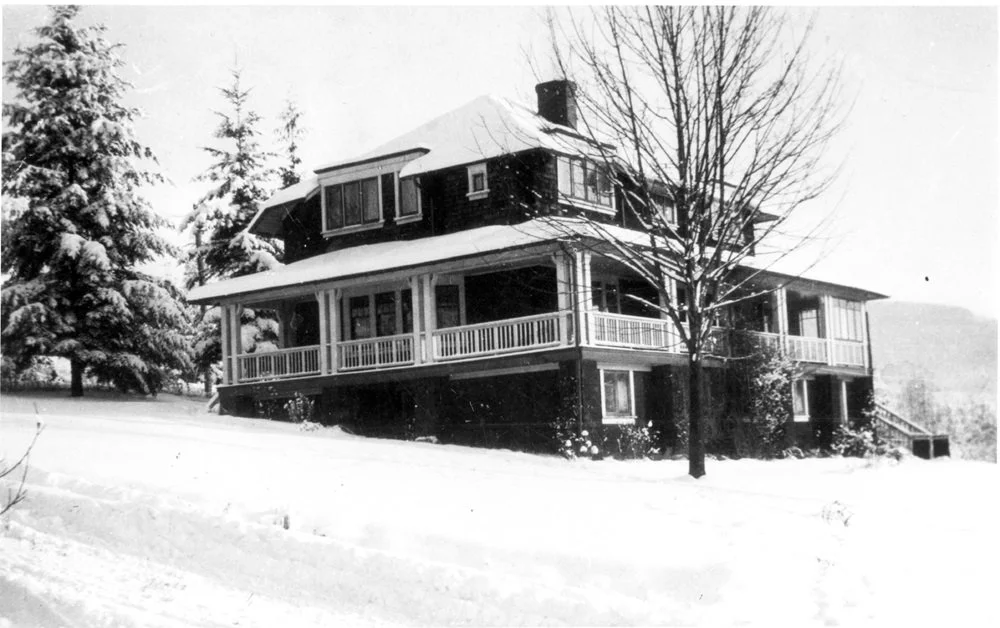
437 Somerset. Inventory 3748 circa 1916. Courtesy of MONOVA/North Vancouver Archives.
My colleague, Jenny Morgan, has written about this house in a previous blog which I encourage you to read as it provides much more detail about the history of this house. However, briefly, this house was built in 1912 for John Magnus, who along with his partner, owned a real estate company called Magnus & Morewood. Called the Tempe House, it is notable for its wraparound verandah. By 1913, only one year later, it was sold to Baron von Alvensleben, a German immigrant who was a real estate and financial broker, who wanted to use the home as a hunting lodge. He enlarged the building for that purpose, but only one year later, in 1914, he and his wife and children fled to the US from Canada due to anti-German sentiments during WWI. Von Alvensleben’s assets in Canada, including the house on Somerset, were seized by the Canadian government. His freedom in the US was short-lived as, soon after he arrived, he was interned by the US government for 3 years due to his German nationality. Once released, he remained in the US and never returned to Canada. It is not clear what happened to his hunting lodge at 437 Somerset during the war or after, but presumably the Canadian government rented out the lodge and eventually sold it. In 1916, when this photo was taken, this house was likely still under Canadian government control but it is unclear who was actually living there, if anyone.
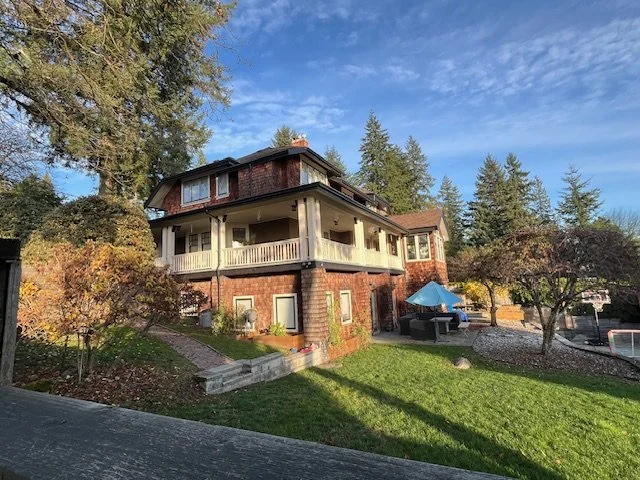
437 Somerset, December 2025, Photo by Jennifer Clay
Larson House (254 West 6th)
This beautiful craftsman house, designed by Blackadder & Mackay, was built for Peter and Gerda Larson. Peter was a successful businessman who owned the North Vancouver and Canyon View Hotels.
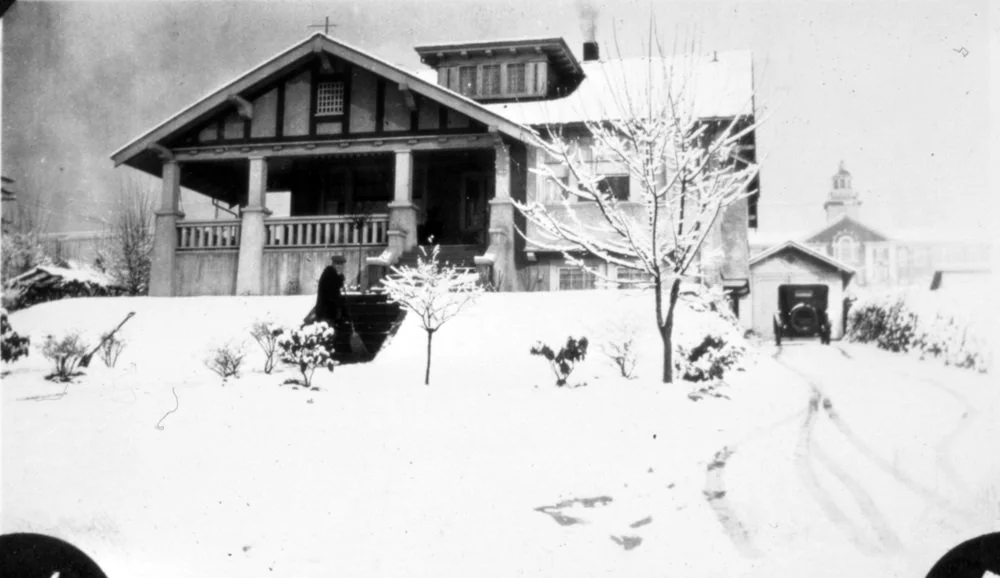
Pete Larson’s home at 254 W 6th St. Queen Mary School in the background. Inventory #6815 circa 1920’s. Courtesy of MONOVA/North Vancouver Archives.
If you look closely at the snowy photo of this house, it looks like Mr. Larson was being a good west coast resident, using a broom to sweep the snow off their front steps. Pictured in the background is the top of Queen Mary School. It is not possible to capture the school in a photo of the Larson House today because in 2007, the Larson House was moved to the west, to make room for a new infill duplex house which blocks our view to the school from West 6th.
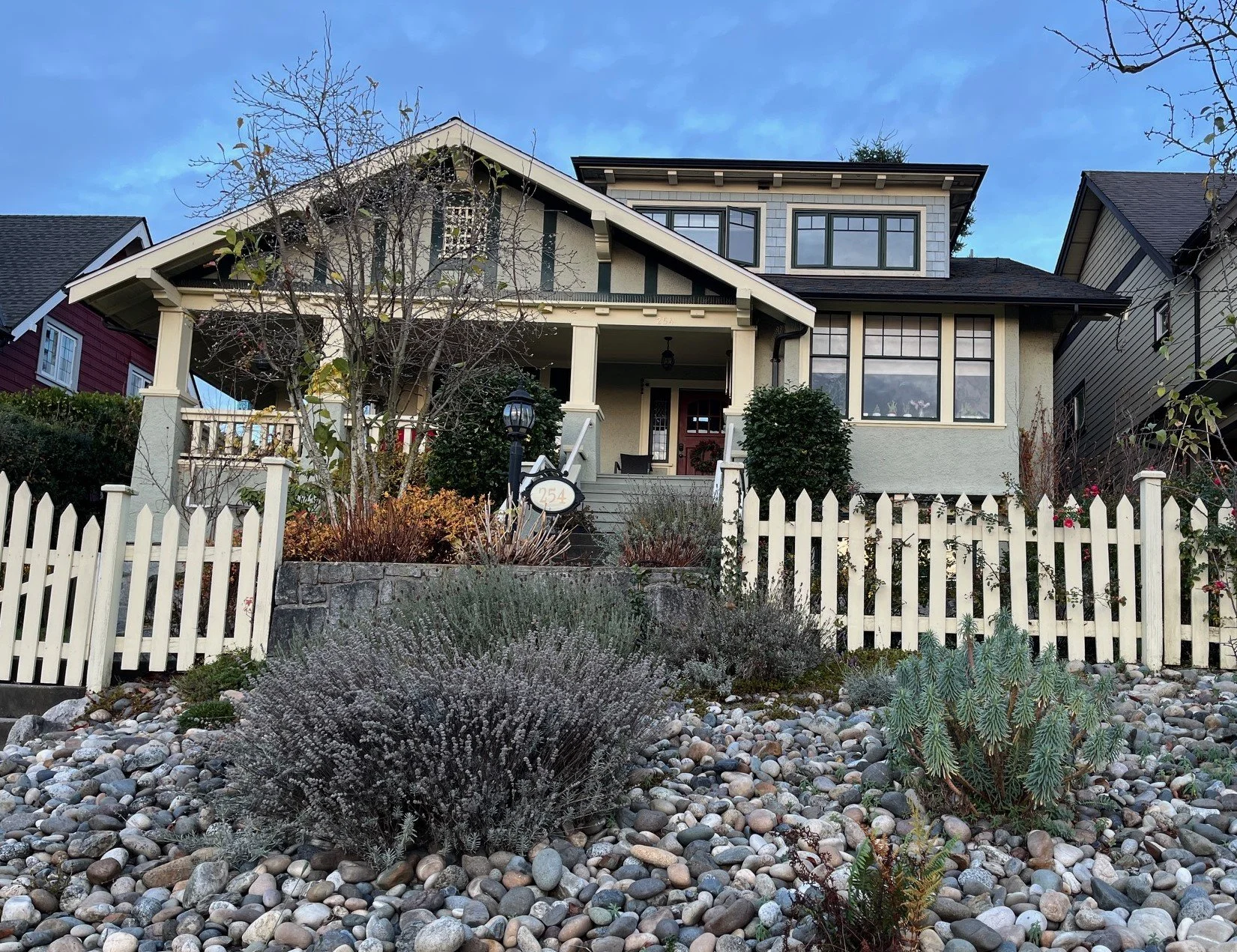
254 West 6th, December 2025. Photo by Jennifer Clay
Lynn Valley Road/Fromme Block
Most of you probably recognize this location! Iconic Lynn Valley!
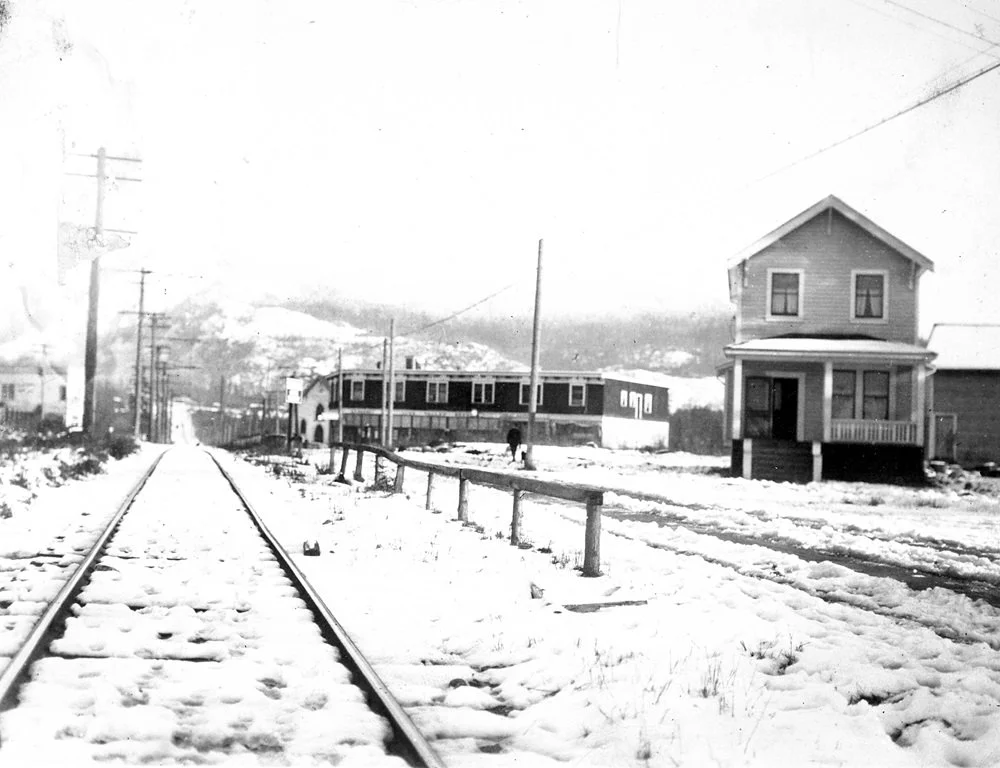
View northeast on Lynn Valley Road. Inventory 6645. Circa mid-1910’s. Courtesy of MONOVA/North Vancouver Archives.
The “house” on the right was the original Lynn Valley General Store, built in 1908. But by 1912, the store was bursting at the seams so Julius Fromme, the owner of the Lynn Valley Lumber Company, built a large commercial block one street away, at the intersection of Centre Road, now called Mountain Highway. This building is called the Fromme Block. The original General Store was converted to a house while the 2nd General Store moved to the main floor of the Fromme Block, sharing that floor with the offices of the lumber company and various other businesses. Today, the TD Bank occupies the main floor of the Fromme Block. The first General Store was converted back into a house as can be seen in this photo but was later demolished.
In addition to the two iterations of the General Store, the Lynn Valley Streetcar line, built in 1910, features prominently in this photo, as well as the Knox Presbyterian Church, just behind the Fromme Block. While the Church itself was demolished in 1967, its foundation was retained and can still be seen in the basement of the Maple Leaf Garden Centre.
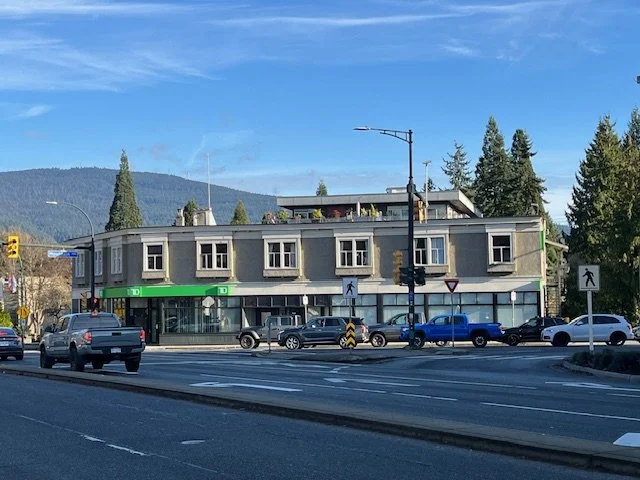
Fromme Block, 2620 Mountain Highway, December 2025. Photo by Jennifer Clay.
Bank of Hamilton and Aberdeen Block
Most of you probably also recognize this location in Lower Lonsdale!
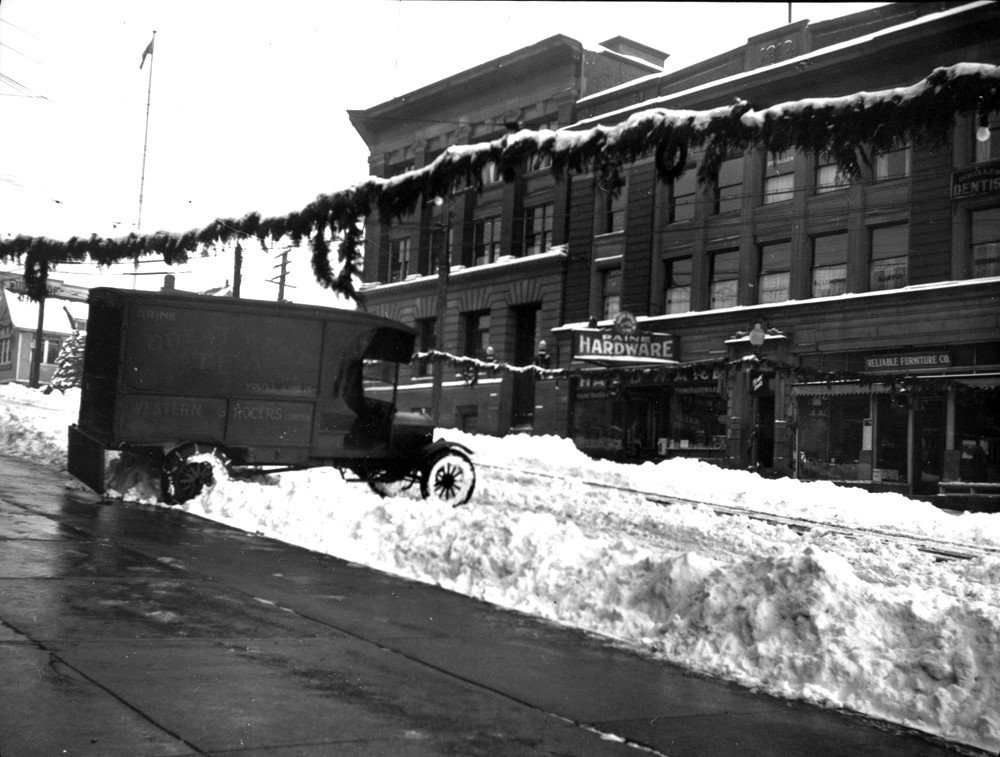
Lower Lonsdale. Canadian Bank of Commerce and Aberdeen Block, Lonsdale Ave. Paine Hardware and Reliable Furniture Co., Western Grocers truck, snow and Xmas greenery. Inventory #7336 (Dec 12, 1927). Courtesy of MONOVA/North Vancouver Archives.
There are two buildings in this photo - the Bank of Hamilton (later Canadian Bank of Commerce) and the Aberdeen Block. They were designed by Mills & Hutton, a Hamilton Ontario architectural firm, and built in 1910-1911. They are located at the foot of Lonsdale.
At the time this photo was taken 98 years ago, on December 12, 1927, the Aberdeen Building housed Paine Hardware and Reliable Furniture on the main floor as well as the Theosophical Society, a number of doctors and some private residents on the upper floors. The Canadian Bank of Commerce had a similar mix of medical offices and residential units, as well as the bank.
I have a personal connection to both buildings! My personal connection to the Bank of Commerce building is that John Bull, the man who built our house, was the manager of the Lonsdale Coal and Building Supply which was located in this building, with the main entrance off of 1st Street, while the 2nd owner of our house, Sam Sowden, was the manager of the Canadian Bank of Commerce. So, both the 1st and 2nd owners of our house worked in this building. And my personal connection to the Aberdeen Block is that my grandfather’s push mower, which I had loaned to Paine Hardware for their antique tool window display, was destroyed in a New Year’s Eve fire in 1997.
The other fun image in the 1927 photo is the Western Grocers truck parked in the snowbank. According to the archival directories, Western Grocers were based on Water Street in Vancouver and were wholesale grocers and importers. So, presumably they were not delivering groceries to the residents of the Aberdeen Block, but were likely delivering groceries to a grocery store in the vicinity. It’s amazing that the truck driver braved what looks like a substantial snowfall to deliver his goods, all the way from Gastown!
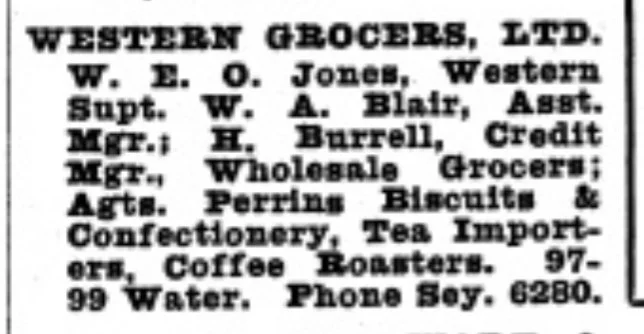
1927 listing for Western Grocers in the City Directory. Courtesy of MONOVA/North Vancouver Archives.
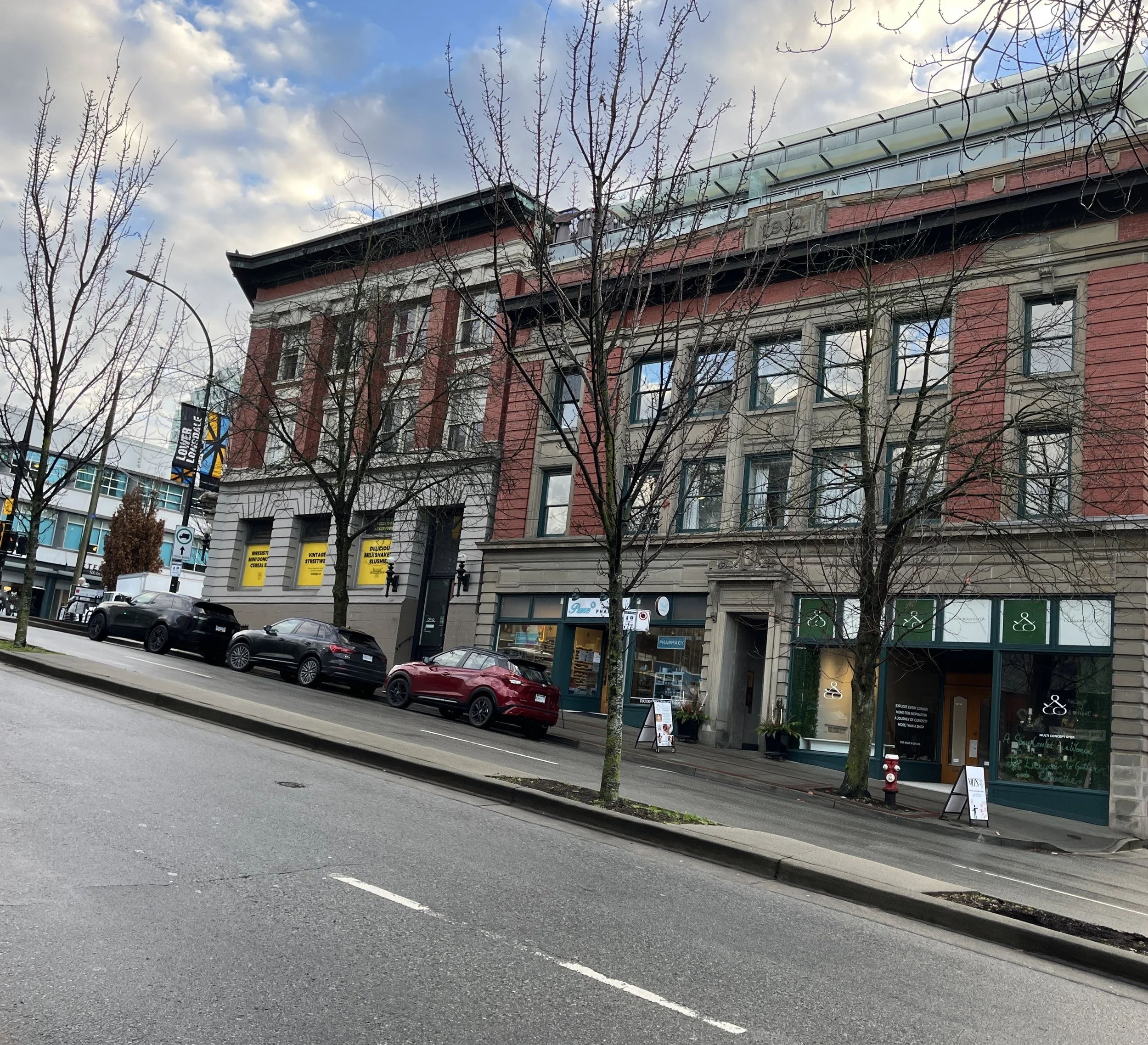
Bank of Hamilton/Canadian Bank of Commerce and Aberdeen Blocks, December 2025. Photo by Jennifer Clay.
A.J. Nye House
The house in this photo was built in 1913 for Alfred John Nye, who was the first British Columbian to return from the Boer War. As a reward for his service, he received a land grant of District Lot 2025 where he built this house using local fir, cedar and granite materials. The most handsome feature of this house is the tapered stone columns which support the porch.
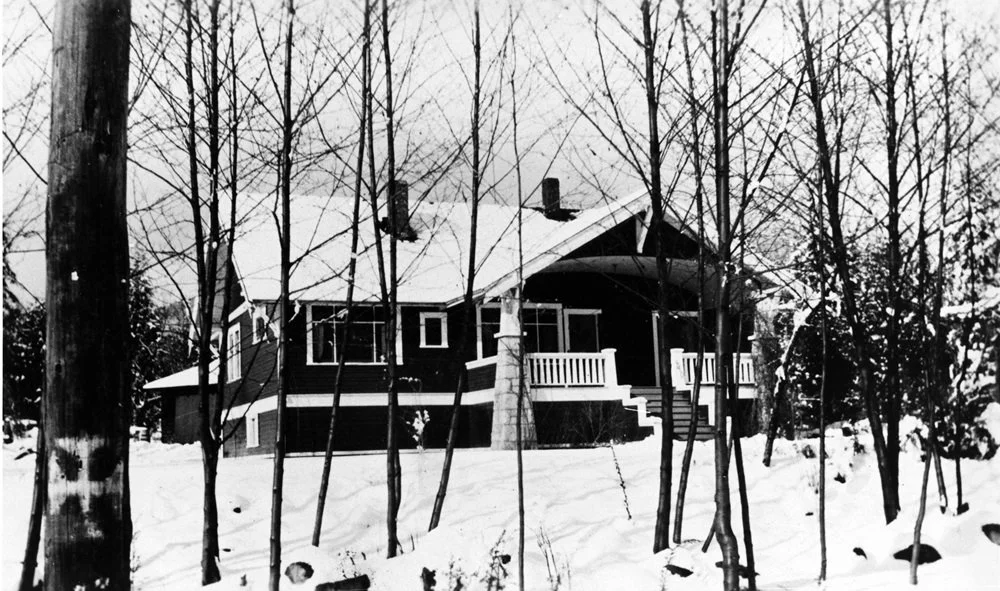
AJ Nye Home. 950 Lynn Valley Road. Inventory 6401 circa 193x. Courtesy of MONOVA/North Vancouver Archives.
It’s now called the Mollie Nye House in honour of the Nye’s daughter, who was a long-time local school teacher. This house was the subject of a Heritage Revitalization Agreement in conjunction with the senior’s housing next door. The Molly Nye House is now owned by the DNV and is operated by Lynn Valley Services Society (LVSS), a non-profit organization. The building serves as a small community centre in Lynn Valley.
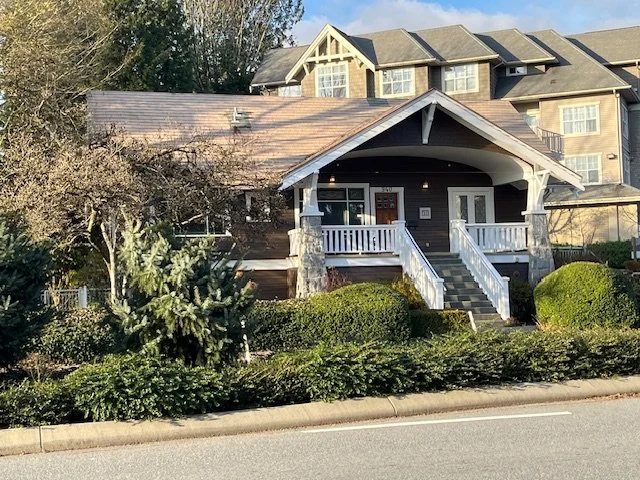
Molly Nye House, December 2025. Photo by Jennifer Clay
I hope you’ve enjoyed our walk through the snowy streets of early 20th century North Vancouver! It’s certainly a lot different from today. These kinds of photos make me wish I could time travel! Let us know what you think of these photos! And last but not least, enjoy the upcoming holiday! I’m wishing for snow but I don’t think Santa will be bringing that this Christmas!
Except where indicated, text and images Copyright @ North Shore Heritage and Jennifer Clay. All rights reserved. Republication in whole or in part is prohibited without the written consent of the copyright holder.